 2 images
市川の梨 幸水梨 千葉県市川産 約5kg 9玉~16玉 和梨 ギフト 贈答用 お中元 送料無料北海道・中国・四国・九州・離島地区別途クール送料760円7月末~8月中旬頃発送日付指定不可
フルーツ大田
4.2 / 70 reviews
¥5,980
View on Rakuten →Japanese · new tab
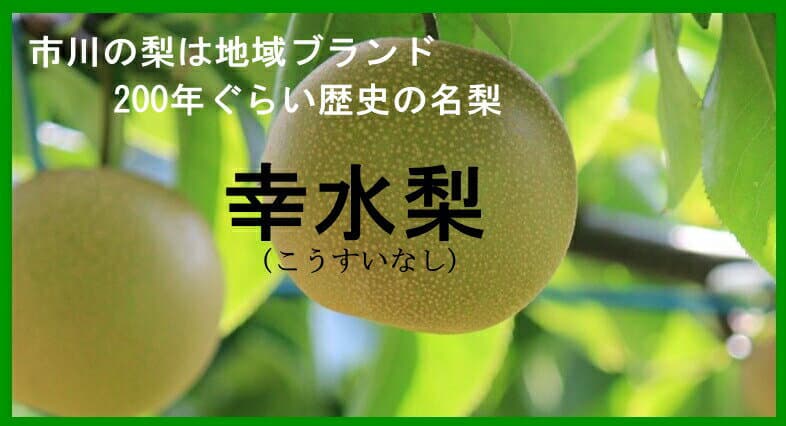
Pear-growing in Chiba's Ichikawa goes back over three centuries — juicy and crisp, August–October.
Ichikawa no Nashi is a pear fruit family from Chiba, identified in the evidence as the regional trademark name “市川の梨.” Its place connection is the Ichikawa name itself, which ties the fruit to that locality; no further climate, history, or technique details are provided in the supplied evidence.
Information updated 64 days ago
2 imagesフルーツ大田
4.2 / 70 reviews
¥5,980
View on Rakuten →Japanese · new tab
In northern Ichikawa, names such as Omachi, Onocho, and Kashiwai give Ichikawa pears a visible place on the map. “Ichikawa no Nashi” refers to pears grown in Ichikawa City, with Kosui, Hosui, Akizuki, and Niitaka among the varieties people meet through the season. From early August into early October, the fruit changes in size, acidity, sweetness, and aroma. Along Route 464, known during harvest as Omachi Pear Road, the city’s pear country sits close to everyday urban life, held together by orchards, Kanto loam, and the simple act of slicing a crisp pear for the table.
The meaning of Ichikawa no Nashi begins with place: pears cultivated within Ichikawa City in Chiba Prefecture. City and JA Ichikawa materials present Kosui, Hosui, Akizuki, and Niitaka as the main varieties, so the local name becomes tangible through fruit that ripens from early August toward early October. The name has also received regional collective trademark protection, a detail that helps mark the boundary around the city-grown crop; for readers, the more immediate meaning is the link among Ichikawa orchards, grower communities, and named pear varieties.
Present-day Ichikawa pear country is strongly associated with the city’s northern districts. Omachi, Onocho, and Kashiwai appear as orchard areas, and Route 464 is known in harvest season as Omachi Pear Road, where farm-stand scenery gathers around the fruit. That geography gives the pears a near-urban character: they belong to a city in Chiba, yet their seasonal image depends on northern orchards, roadside stands, and trees rooted beyond the denser residential center.
The local timeline reaches back to the Edo period through Kawakami Zenroku of Yawata. He brought pear branches from Ogaki in Mino and tried growing them around Katsushika Hachimangu; Chiba’s pear history places an important spread of cultivation in Yawata, now part of Ichikawa, in 1769. Early growing areas included Yawata, Ichikawa, and Nakayama, before orchards moved north as urbanization and the Sobu Line changed the city. Here, tradition means named people and places: Kawakami Zenroku, Katsushika Hachimangu, Yawata, and the later northern orchard districts.
Ichikawa’s well-drained Kanto loam is described as suitable for fruit trees, giving pear cultivation a soil base that can handle water without holding too much of it. In the wider Chiba pear context, warm climate, volcanic-ash soils with good drainage and nutrient-holding capacity, sunlight reaching many Kosui and Hosui fruits, soil building, pruning, fertilizer choices, and harvest timing all shape ripeness and flavor. These growing details should be read as Chiba pear context rather than proof that every Ichikawa orchard works identically.
Ichikawa’s pear season opens with Kosui from roughly early to late August, known for juiciness, clear sweetness, and low acidity. Hosui follows around late August to early September with larger fruit and a balance of sweetness and acidity. Akizuki arrives around early to late September with size, juiciness, and gentle sweetness, while Niitaka appears from late September into early October; it can reach about 500 to 700 grams, with strong sweetness, low acidity, and aroma. The sequence turns one city’s harvest into several textures and flavors rather than a single pear taste.
Ichikawa pears also carry a breeding memory through Ishii Kanekichi. In 1916, he created Ishii Wase through artificial crossing, and Ichikawa retains memory of the original tree. JA Ichikawa connects Ishii Wase with later familiar varieties Hosui and Akizuki, showing that local growers were involved not only in cultivation but also in the shaping of pear variety history. The cultural meaning here is concrete: a named farmer, a crossing in 1916, a variety called Ishii Wase, and its link to fruit still recognized today.
At the table, Ichikawa pears ask for small, practical care. Chilling the fruit for one to two hours before eating brings out a cool texture, while long chilling is unnecessary. Peeling thinly matters because sweetness is concentrated near the skin, especially toward the bottom of the pear. That serving habit keeps the orchard work close to the plate: Kosui’s juice, Hosui’s sweet-tart balance, Akizuki’s gentle sweetness, and Niitaka’s large aromatic flesh are easier to notice when less of the sweet outer layer is cut away.
Ichikawa pears are best understood through concrete points on a local map: Omachi, Onocho, Kashiwai, Route 464, Katsushika Hachimangu, and the well-drained Kanto loam beneath the orchards. Add the seasonal order of Kosui, Hosui, Akizuki, and Niitaka, plus the memory of Ishii Kanekichi and Ishii Wase, and the fruit becomes a compact history of place, soil, growers, and table habits in one Chiba city.
Compiled from public records and official sources; see the recognition links below. Details may change over time.
Where this selection is officially registered, designated, or recognized in Japan.
Regional collective trademark
Registered as a Regional Collective Trademark with the Japan Patent Office.
Sources1
Fresh produce doesn't keep, so start with the grower's note in the box. Most fruit ripens best at room temperature and is at its most fragrant when it reaches eating condition; refrigerate only once it is cut or fully ripe, and eat it soon after. Chilling too early stalls ripening and flattens the flavour. Follow the listing and the enclosed note for the specific variety.
市川の梨 is a regional foods from Chiba. We compile its regional connection and characteristics against official registries, local sources, and live Rakuten listings.
This is a temperature- or fragility-sensitive item — before travelling, confirm refrigerated/frozen delivery, packaging, and arrival dates on the Rakuten listing. For gifts, prefer shelf-stable, boxed options.
We don't sell directly. This page compiles Rakuten listings and affiliate links; purchase, payment, stock, and delivery all happen on the Rakuten listing.