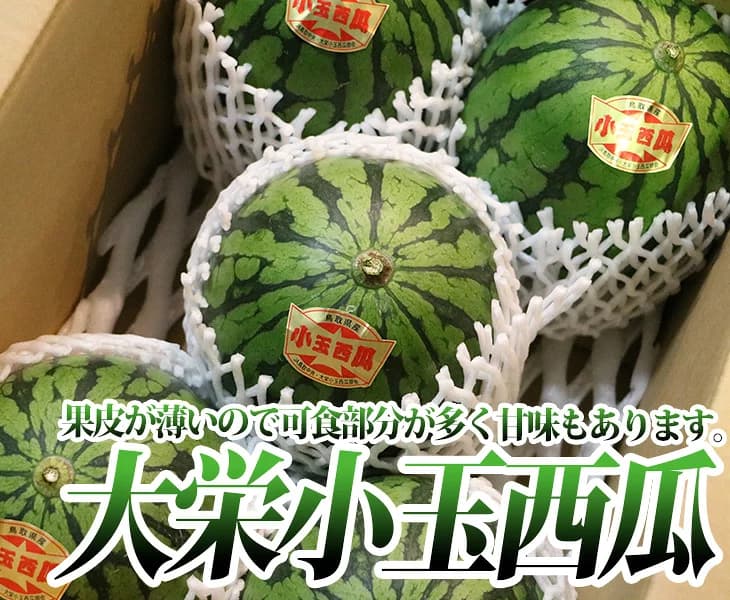
 3 images
Tottori Daiei Kodama Watermelon
【送料無料】鳥取県産 大栄小玉西瓜【1玉】【 鳥取県産 大栄西瓜 大栄小玉西瓜 西瓜 小玉 スイカ すいか 家庭用 贈り物 贈答 お祝い お返し フルーツギフト プレゼント フルーツ お取り寄せ うまい 果物】
1 watermelonしらさぎ青果
1.0 / 1 reviews
Japanese name大栄西瓜
In Hokuei, Kotoura, and Kurayoshi, Daiei Suika grows near Mount Daisen in black volcanic soil, with rain-shelter fields, two or three fruits per plant, and careful checks before the early-summer sendoff.
Information last updated 20 days ago
3 images【送料無料】鳥取県産 大栄小玉西瓜【1玉】【 鳥取県産 大栄西瓜 大栄小玉西瓜 西瓜 小玉 スイカ すいか 家庭用 贈り物 贈答 お祝い お返し フルーツギフト プレゼント フルーツ お取り寄せ うまい 果物】
1 watermelonしらさぎ青果
1.0 / 1 reviews
First time buying on Rakuten? How residents in Japan order →
Daiei Suika carries the name of former Daiei Town in Tottori. After Daiei Town merged with Hojo Town in 2005 to form Hokuei, the watermelon name remained; today the production area covers Hokuei, Kotoura, and Kurayoshi. The fields sit near the foothills of Mount Daisen, where fertile black volcanic soil holds water while letting it drain, giving this central Tottori watermelon a clear place behind its name.
Daiei has disappeared from the current municipal map, yet it remains on the watermelon. The production area now includes Hokuei, Kotoura, and Kurayoshi, while the name points back to former Daiei Town before the 2005 merger. A watermelon carrying the Daiei Suika name must come from the defined area and follow shared rules for selected varieties, cultivation, ripening, inspection, and joint sorting.
The growing area lies near Mount Daisen, a landmark of Tottori and the highest peak in the Chugoku region. The fields are formed from fertile kuroboku, a black volcanic soil described as both water-retentive and permeable. Those soil conditions also explain why production extends beyond Hokuei into Kotoura and Kurayoshi, where similar ground supports watermelon fields. The concrete place behind Daiei Suika is this Daisen foothill soil and the central Tottori towns around it.
Watermelon growing here has more than a century behind it. In 1907, Sakamoto Chozo opened a watermelon field in Yura village, now part of Hokuei's Tsumami area, and a 2007 centennial event in Hokuei marked 100 years since watermelon was introduced there. In 1973, the Daiei Town agricultural cooperative watermelon council formed and adopted Daiei Suika as a unified name. Tradition here is practical: a field, a grower community, a shared name, sorting work, and seasonal departures from Hokuei.
The growing method is precise enough to picture. Varieties are selected through test cultivation within the production area, and growers use pipe houses or open-field tunnels for rain-shelter cultivation. Each plant is limited to two or three fruits. These choices concentrate attention on fewer watermelons and reduce the effect of rain on field growth. The quality boundary for Daiei Suika is therefore tied to visible farm work: selected varieties, covered rows, fruit limits, and shared cultivation methods.
A Daiei Suika watermelon is ripened to about 48 days after pollination, then must weigh at least 3.0 kilograms, reach at least 11 degrees of sugar content, and show no rot, deterioration, or disease. Before the season's departure flow, each fruit is checked by tapping and then handled through joint sorting. The family is also described as having little variation in shape and a small difference in sweetness between the center and the flesh near the rind. Its consistency comes from counted field days, weight and sugar thresholds, fruit health, and hands-on inspection.
On June 10, 2025, Hokuei held the first-sendoff ceremony for Daiei Suika, and 27,000 watermelons were loaded onto trucks bound for Kansai and Kanto. That season involved 194 grower households cultivating 150 hectares, with targets of 530,000 cases and 1 million watermelons; 28 children from a Hokuei nursery school also sang as the trucks left. The seasonal scene gives the crop a human scale: growers, the association, children, trucks, and large 3L-centered watermelons described as high in sugar with a crisp texture.
Daiei Suika reaches the early-summer sendoff through a link between field judgment and shared sorting. The local timeline marks the completion of an integrated watermelon sorting plant in 1994, and in 2007 new sorting equipment was introduced with sugar sensors, grade judgment, automatic transfer, and automatic boxing. Those machines sit beside older forms of shared work: the 1973 naming decision, one-by-one tapping checks, and joint sorting. Continuity is concrete here, found in the association, the sorting plant, the sensors, and the watermelons that leave Hokuei each early summer.
Daiei Suika begins with a place name from old Daiei Town, then becomes more specific through Tottori fields, kuroboku soil, rain-shelter rows, two or three fruits per plant, about 48 days of ripening, tapping checks, and joint sorting. The name stayed after the map changed because Hokuei, Kotoura, and Kurayoshi still give it a working shape in the field and at the sorting plant.
Compiled from public records and official sources; see the recognition links below. Details may change over time.
Where this product is officially registered, designated, or recognized in Japan.
Geographical Indication (GI)
Registered under Japan's Geographical Indication Protection System, run by the Ministry of Agriculture, Forestry and Fisheries.
Sources1
It is written as 大栄西瓜 in Japanese. Search Rakuten and other Japanese sites with that spelling — the English name will not bring up the listings.
Daiei Suika is a named watermelon family from Hokuei, Kotoura, and Kurayoshi in Tottori, retaining the place name of former Daiei Town. Its fields lie near Mount Daisen, where fertile black volcanic soil holds water and drains well. Growers use selected varieties, rain-shelter cultivation, and two or three fruits per plant; watermelons ripen about 48 days after pollination, must meet weight, sugar, and health standards, and are checked by tapping before joint sorting.
The name Daiei in Daiei Suika comes from former Daiei Town, which became part of Hokuei after a 2005 merger. In 1973, the Daiei Town agricultural cooperative watermelon council formed and adopted Daiei Suika as a unified name. At the June 10, 2025 first-sendoff ceremony in Hokuei, 27,000 Daiei Suika watermelons were loaded onto trucks.
Daiei watermelons are shipped fresh from June 10 through mid-July, and the fruit is described as large, high in sugar, and crisp. The watermelons are shipped from Hokuei to the Kansai and Kanto regions, mainly toward Keihanshin, with nationwide distribution through mid-July.
Fresh produce doesn't keep, so start with the grower's note in the box. Most fruit ripens best at room temperature and is at its most fragrant when it is ready to eat; refrigerate only once it is cut or fully ripe, and eat it soon after. Chilling too early stalls ripening and flattens the flavour. Follow the listing and the enclosed note for the specific variety.
Most options are shelf-stable, boxed, and travel well, so they suit gifting or bringing home. Confirm the final storage and delivery terms on the Rakuten listing.
On Rakuten: the shops listed here right now are しらさぎ青果. We don't sell directly; purchase, payment, stock, and delivery are all handled on the Rakuten product page.