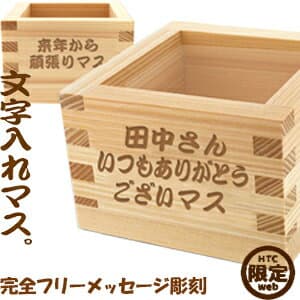
 3 images
Ogaki Wooden Masu with Custom Message Engraving
【大垣の木枡】メッセージ入り枡完全フリーメッセージ彫刻 枡 名入れ オリジナル枡 作成 コンペ 記念品 コンペ景品 参加賞 ゴルフ 名前入り プレゼント 名入れギフト 制作 おもしろ 定年 結婚祝い 還暦祝い 敬老の日 母の日 父の日 送別会 記念品 オリジナルグッズ制作
1-go size, 1 pieceHTCゴルフ
5.0 / 2 reviews
Japanese name大垣の木枡
Wood & bamboo tableware overview
In Gifu Prefecture’s Ogaki City, wooden masu carry hinoki scent, arare-gumi corners, and disk-planer surfaces from rice-measure use into sake service and event keepsakes.
Information last updated 120 days ago
3 images【大垣の木枡】メッセージ入り枡完全フリーメッセージ彫刻 枡 名入れ オリジナル枡 作成 コンペ 記念品 コンペ景品 参加賞 ゴルフ 名前入り プレゼント 名入れギフト 制作 おもしろ 定年 結婚祝い 還暦祝い 敬老の日 母の日 父の日 送別会 記念品 オリジナルグッズ制作
1-go size, 1 pieceHTCゴルフ
5.0 / 2 reviews
First time buying on Rakuten? How residents in Japan order →
Hold an Ogaki no Kimasu and the first details are physical: a square wooden vessel, the scent of domestic hinoki, corners joined with arare-gumi, and a surface finished by disk planer. The name belongs to wooden masu made in Ogaki City, Gifu Prefecture, including masu used as sake vessels. Its older role as a measure for rice and similar goods still sits behind its newer places at sake service and celebratory events.
Ogaki City is the starting point for understanding the wooden masu. About 80 percent of Japan’s masu production is made in Ogaki, making the city a central production place for the form. The name Ogaki no Kimasu points first to wooden masu produced in Ogaki City, including the wooden masu used as sake vessels; before any larger meaning is added, the object is a square wooden vessel tied to a specific city and use.
Ogaki’s masu industry began in the mid-Meiji period, when craftspeople brought masu-making skills into the area. Nearby places with good hinoki also helped production become active. The beginning is concrete: moving hands, a city ready for production, and hinoki close enough to support the making of wooden masu. That combination gives the small square vessel a clear place-based origin without needing a grand legend around it.
Domestic hinoki gives Ogaki’s wooden masu one of its most immediate sensory traits. The vessel is small enough to hold, and the scent of the wood sits close to the act of pouring sake. In that moment, the local character is not an abstract claim; it is Ogaki-made woodwork, hinoki aroma, and a square form that can be lifted in one hand.
The workmanship boundary is named through two concrete features: arare-gumi joinery and disk-planer surface finishing. Arare-gumi belongs at the corners where the pieces meet; the disk-planer finish belongs to the surface touched by the fingers. These terms can sound technical, but on the masu they become easy to locate: look to the corners, then to the wooden face, and the vessel’s quality conditions become visible in the object itself.
Masu were once used in Japan as measuring vessels for rice and similar goods, and that older use remains part of the square form’s memory. Ogaki’s wooden masu continue in newer roles as sake vessels and auspicious keepsakes for events. The same compact wooden shape moves from measuring rice to holding sake and marking a celebration, carrying practical use into moments of gathering.
In 2020, Ogaki no Kimasu and Ogaki no Masu were recognized as regional collective trademarks. For the vessel itself, that status points back to concrete boundaries: Ogaki-made masu, quality conditions, and local efforts to maintain masu quality while developing the industry and the city’s recognition. Cards introducing the two names are distributed at the Ogaki Chamber of Commerce and the Oku no Hosomichi Musubi no Chi Memorial Hall, so visitors can meet the names in Ogaki as well as the vessel.
Ogaki no Kimasu is strongest when seen at hand scale: Gifu’s Ogaki City, domestic hinoki scent, arare-gumi corners, disk-planer finishing, and the vessel’s path from rice measure to sake service. It is a small square object, but within that shape it keeps together a city of production, a fragrant wood, and the everyday act of holding a wooden cup.
Compiled from public records and official sources; see the recognition links below. Details may change over time.
Where this product is officially registered, designated, or recognized in Japan.
Regional collective trademark
Registered as a Regional Collective Trademark with the Japan Patent Office.
Sources1
It is written as 大垣の木枡 in Japanese. Search Rakuten and other Japanese sites with that spelling — the English name will not bring up the listings.
Ogaki wooden masu (Ogaki no Kimasu) are square wooden masu made in Ogaki City, Gifu Prefecture, including masu used as sake vessels. The local masu industry began in the mid-Meiji period when craftspeople brought masu-making skills to the area, supported by nearby good hinoki-producing places. The vessels are known for domestic hinoki scent, arare-gumi corner joinery, and disk-planer finishing, with uses ranging from rice measuring to sake service and auspicious event keepsakes.
Ogaki City accounts for about 80 percent of Japan's masu production. Masu were historically used to measure rice and similar goods. In 2020, Ogaki no Kimasu and Ogaki no Masu were recognized as regional collective trademarks, aimed at maintaining quality and developing the masu industry. Cards introducing Ogaki no Kimasu and Ogaki no Masu are distributed at the Ogaki Chamber of Commerce and the Oku no Hosomichi Musubi no Chi Memorial Hall.
The masu can be used as a sake vessel, serving drink for guests. It is also used as a commemorative keepsake for auspicious events. Users can appreciate the scent of domestic hinoki and the arare-gumi joinery technique.
Porous earthenware is usually given a "medome" treatment first — simmer it gently in rice-rinsing water (or water with a little flour), then cool, rinse, and air-dry. This reduces staining and odour absorption. Porcelain normally just needs a wash. Follow the listing where it says otherwise.
Handmade earthenware, pieces with gold or silver overglaze, and lacquerware generally should not go in a dishwasher, microwave, or heated drying cabinet; heat-resistant porcelain usually can. Check the Rakuten listing for the specific piece.
Most options are shelf-stable, boxed, and travel well, so they suit gifting or bringing home. Confirm the final storage and delivery terms on the Rakuten listing.
On Rakuten: the shops listed here right now are HTCゴルフ. We don't sell directly; purchase, payment, stock, and delivery are all handled on the Rakuten product page.