 2 images
Okayama Hakuto Royal White Peaches
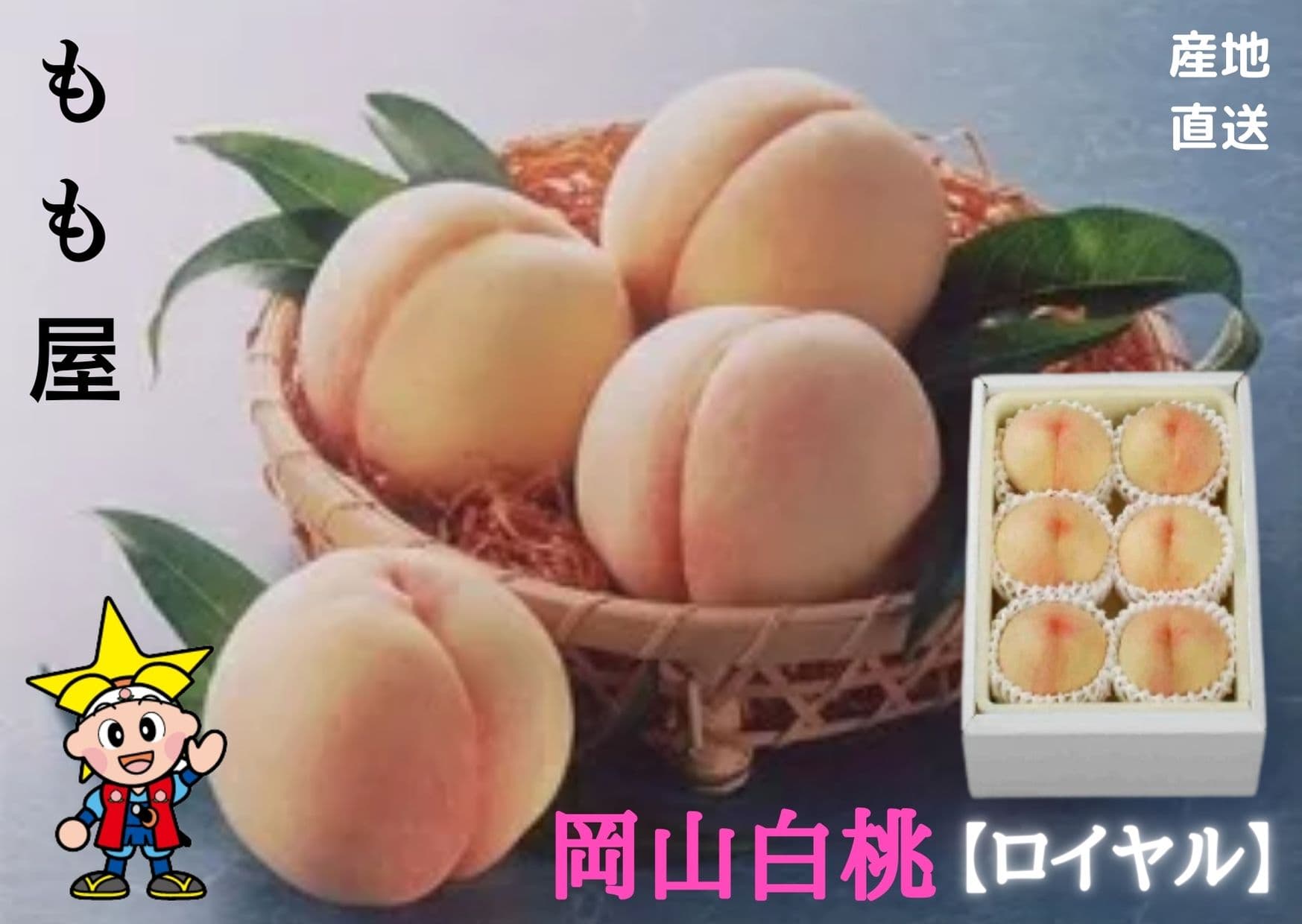
★予約販売★【産直品】お中元【送料無料 】岡山白桃【ロイヤル】 4〜6個 約1.4kg 贈答用 ギフト 【送料無料 但し※別途北海道・沖縄送料1,500円】
4-6 peaches, approx. 1.4kg有限会社もも屋
4.3 / 81 reviews
Japanese name岡山白桃
Bagged on the branch to a pale, delicate blush — Okayama's flagship gift peach, at its best in July–August.
In Okayama Prefecture, mild Setouchi weather, cultivar succession, and one-fruit-one-bag growing shape white peaches with soft flesh and a pale finish.
Information last updated 120 days ago
2 images★予約販売★【産直品】お中元【送料無料 】岡山白桃【ロイヤル】 4〜6個 約1.4kg 贈答用 ギフト 【送料無料 但し※別途北海道・沖縄送料1,500円】
4-6 peaches, approx. 1.4kg有限会社もも屋
4.3 / 81 reviews
First time buying on Rakuten? How residents in Japan order →
Okayama Hakuto refers to white peaches grown in Okayama Prefecture, where the mature fruit is known for pale, almost milky skin. That color begins early in the orchard: when each young peach is about the size of a ping-pong ball, growers cover it with a light-blocking bag and keep it away from direct sun until harvest. The name also carries a seasonal rhythm, with cultivars such as Shimizu Hakuto, Okayama Yume Hakuto, Hakurei, Setouchi Hakuto, Hakuo, and Fuyumomogatari moving the peach season from mid-June into mid-December.
The boundary of Okayama Hakuto starts with white peaches produced in Okayama Prefecture. Under that regional name, several cultivars appear in sequence, including Shimizu Hakuto, Okayama Yume Hakuto, Hakurei, Setouchi Hakuto, Hakuo, and Fuyumomogatari. JA Hare no Kuni Okayama treats peaches as a major crop across its service area and explains that the best window for one cultivar may last about one to three weeks, so the season continues through cultivar changeover. The regional character of this fruit is concrete: Okayama orchards, pale skin, named cultivars, and harvest timing.
Okayama’s peach season is shaped by place as much as by cultivar. The Setouchi area has a mild climate, and JA describes shipping timing that differs between warmer southern plains and northern intermediate mountain areas, even for the same cultivar. Early fruit appears from mid-June, while Fuyumomogatari reaches late November to mid-December, giving Okayama Hakuto a long seasonal arc built from temperature differences, orchard locations, and cultivar planning.
Two dates anchor the family’s continuity. In the early Meiji period, Hakuto was created in Okayama through breeding, and full-scale cultivation began from there. In 1932, Shimizu Hakuto was found in a mixed orchard of Hakuto and Okayama No. 3. JA describes Shimizu Hakuto as having very pale skin and flesh, dense flesh, abundant juice, fragrance, and sweetness, so the history stays tied to a named cultivar, an orchard discovery, and sensory traits.
The pale color of Okayama Hakuto comes from repeated handwork in the orchard. When the young fruit is about ping-pong-ball size, growers place a bag over each peach; the bag protects against insects, wind, and rain, and in Okayama the material blocks light strongly so direct sun is kept off the fruit until harvest. This practice helps preserve the white skin, reduces fibrousness in the fruit, and supports a smooth, tender, melting texture.
The white skin also makes handling demanding because bruises show easily. JA notes that sorting sites check sweetness with sugar sensors or tasting, while people examine color and shape; INPIT adds that harvesting, sorting, and shipping require great care. The quality boundary of Okayama Hakuto therefore continues after harvest, through gentle handling, visual sorting, and sweetness checks on the line.
At home, JA recommends ripening the peach at room temperature until fragrance develops and the skin takes on a milky-white look, then chilling it briefly before eating. Because sweetness is stronger near the skin, the peel should be removed thinly; in production areas, people may wash off the fuzz and eat the fruit skin-on, especially firmer early Hakuho-type peaches. JA’s kitchen examples also include peach salad, peach shiraae, peach spring rolls, and a whole white-peach fruit sandwich with drained yogurt.
Recent extensions of Okayama Hakuto include export coordination and processing experiments. Producers and companies formed an export-promotion council to work on quality standardization, residue-regulation awareness, collection and sorting systems for small farms, and cold-chain development. One Okayama farm also blends several white-peach cultivars into puree, works quickly from peeling to finishing to limit oxidation, and uses the puree in water, soda, smoothies, and shaved ice.
What makes Okayama Hakuto memorable is the meeting of a place name, Setouchi climate, early Meiji white-peach cultivation, and the light-blocking bag placed on each small fruit. When a ripe peach remains pale, it carries cultivar succession, sweetness checks, visual sorting, and careful handling; when it reaches the table, its fragrance, juice, and sweetness near the skin make that orchard work visible in taste.
Compiled from public records and official sources; see the recognition links below. Details may change over time.
Where this product is officially registered, designated, or recognized in Japan.
Regional collective trademark
Registered as a Regional Collective Trademark with the Japan Patent Office.
Sources1
It is written as 岡山白桃 in Japanese. Search Rakuten and other Japanese sites with that spelling — the English name will not bring up the listings.
Okayama white peaches (Okayama Hakuto) are white peaches grown in Okayama Prefecture, including Shimizu Hakuto, Okayama Yume Hakuto, Hakurei, Setouchi Hakuto, Hakuo, and Fuyumomogatari. Pale skin comes from bagging each fruit from about ping-pong-ball size with light-blocking material; blocking direct sun is also tied to less fibrous, smooth, tender flesh. Cultivar succession and climate differences between the southern plains and northern intermediate mountain areas stretch the season.
Hakuto was created in Okayama through breeding in the early Meiji period, after which full-scale cultivation began. Shimizu Hakuto was discovered in 1932 in a mixed orchard of Hakuto and Okayama No. 3. The Okayama peach season runs from mid-June early cultivars to Fuyumomogatari in late November through mid-December. Because bruising is conspicuous on the pale fruit, harvesting, sorting, and shipping require careful handling.
JA recommends ripening at room temperature until aroma develops, holding the fruit gently because pressing can brown it, and chilling only shortly before eating. Sweetness is stronger near the skin, so JA recommends peeling thinly; in production areas people often wash off the fuzz and eat the peach with the skin still on, especially firmer early 白鳳-type peaches. JA recipe examples include peach salad, peach shiraae, peach spring rolls, and a whole white-peach fruit sandwich with drained yogurt.
Fresh produce doesn't keep, so start with the grower's note in the box. Most fruit ripens best at room temperature and is at its most fragrant when it is ready to eat; refrigerate only once it is cut or fully ripe, and eat it soon after. Chilling too early stalls ripening and flattens the flavour. Follow the listing and the enclosed note for the specific variety.
Most options are shelf-stable, boxed, and travel well, so they suit gifting or bringing home. Confirm the final storage and delivery terms on the Rakuten listing.
On Rakuten: the shops listed here right now are 有限会社もも屋. We don't sell directly; purchase, payment, stock, and delivery are all handled on the Rakuten product page.