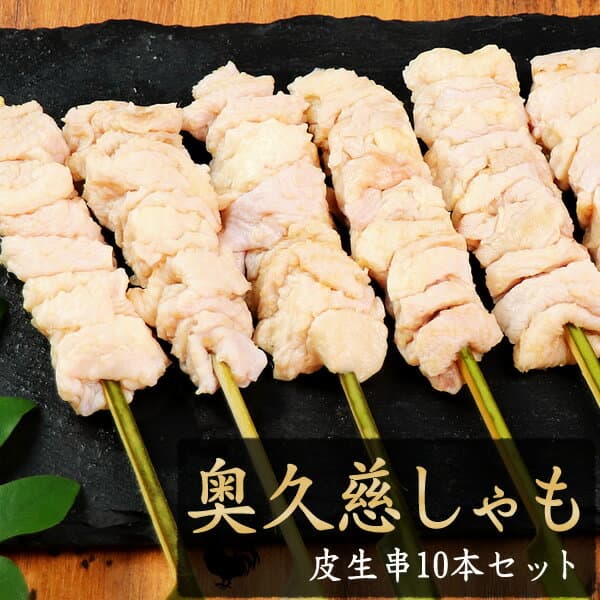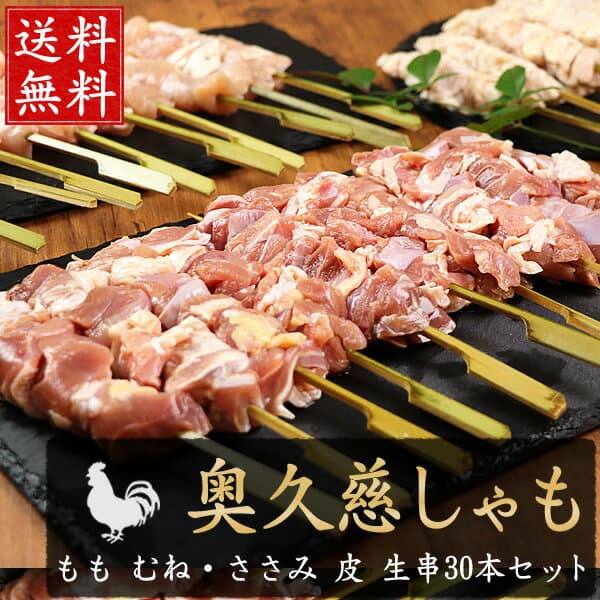
Okukuji Shamo Raw Yakitori Skewer Set
地鶏 奥久慈しゃも 焼き鳥 生 串 30本セット [ 生・冷凍 ][もも串10本 胸ささみ串10本 皮串10本 / 鶏肉 軍鶏 奥久慈軍鶏 国産 キャンプ BBQ バーベキューセット 食材 肉 串 焼鳥 やきとり 生串 職人 手刺し おすすめ 食いしんぼう祭 ]【冷凍限定配送】
水郷のとりやさん
5.0 / 3 reviews
Japanese name奥久慈しゃも
Across Daigo, Hitachiomiya, Hitachiota, and Takahagi, flat-floor farms raise a shamo-line chicken for 120 to 156 days, shaping firm lean meat and a rich stock from sturdy bones.
Information last updated 166 days ago
Ordering from abroad works when the recipient has a Japanese address.
1 of the 3 listings below is sold as a gift in the shop's own wording (ギフト, のし対応 …), marked “Gift-ready”.
地鶏 奥久慈しゃも 焼き鳥 生 串 30本セット [ 生・冷凍 ][もも串10本 胸ささみ串10本 皮串10本 / 鶏肉 軍鶏 奥久慈軍鶏 国産 キャンプ BBQ バーベキューセット 食材 肉 串 焼鳥 やきとり 生串 職人 手刺し おすすめ 食いしんぼう祭 ]【冷凍限定配送】
水郷のとりやさん
5.0 / 3 reviews
【クーポンで10%オフ】お買い物マラソン 国産地鶏 奥久慈しゃも 中抜き丸鶏 1羽 約1.5?2.5kg 国産 鶏肉 丸鶏 中抜き 国産 地鶏 とり肉 鳥肉 国産鶏 ブランド肉 高級 美味しい 丸ごと 冷凍チキン 丸ごとチキン 冷凍肉 冷凍地鶏 バーベキュー
食肉本舗
地鶏 奥久慈しゃも 焼き鳥 皮 生 串 10本セット [ 生・冷凍 ][ 鶏肉 軍鶏 奥久慈軍鶏 国産 キャンプ BBQ バーベキューセット 食材 肉 串 焼鳥 ヤキトリ やきとり 生串 ギフト 職人 手刺し おすすめ 人気 ]【 冷凍 限定配送 】
水郷のとりやさん
4.0 / 5 reviews
First time buying on Rakuten? How residents in Japan order →
Okukuji shamo belongs to the hilly north of Ibaraki, with raising areas in Daigo, Hitachiomiya, Hitachiota, and Takahagi. Daigo describes the bird through the wide temperature swings of the Okukuji landscape, and local tables carry that texture into nabe, oyakodon, soba, curry, and ramen. The product’s character is easiest to understand through place, time, movement, and the way the meat holds its chew in a hot pot or bowl.
Okukuji shamo is tied to a northern Ibaraki raising area rather than to one town alone. The listed area includes Kuji-gun Daigo, Hitachiomiya, Hitachiota, and Takahagi, while Daigo frames the bird within Okukuji Daigo’s natural setting and large day-to-night temperature changes. Those concrete places give the name its shape: hill and mountain country, four municipalities, and a climate that sits close to the way the chicken is described.
The breed line uses male shamo with female Nagoya breed and Rhode Island Red genetics. Daigo explains that shamo came from Siam in the Edo period, was difficult to keep in groups because of its fighting temperament, and was later improved by the Ibaraki Poultry Experiment Station to reduce aggression and improve fertility. The growing period is slow by ordinary chicken standards: males are shipped at about 120 to 125 days, and females at about 150 to 156 days, compared with broilers that reach market size in roughly 50 days.
The daily production picture centers on flat-floor raising and room to move. Daigo-area descriptions mention grains and greens, while the Japan Chicken Association lists dedicated compound feed; together, those details point to a bird raised for texture over speed. Exercise is repeatedly linked with lower fat and tighter meat, so the chew of Okukuji shamo begins before cooking, in the way the birds are allowed to walk and grow.
Okukuji shamo is described through lean, firm meat and a soup made richer by thick-boned carcasses. Daigo notes that the meat works well simmered or grilled, and the Japan Chicken Association describes umami-rich meat with a stock that adds depth to cooking. The appeal is physical and specific: springy bite, low fat, concentrated chicken flavor, and bones that carry taste into a pot of broth.
In Daigo, the bird appears in nabe, oyakodon, soba, curry, karaage, and ramen. Daigo’s shamo nabe is described in salt and soy-sauce styles, and ramen can draw on both meat and bone-based soup; the tourism association also lists soba, oyakodon, and curry among familiar preparations. Each dish uses a different strength: nabe shows meat and broth, rice bowls hold the meat with egg, and noodle bowls let the bone stock spread through the soup.
The Okukuji Shamo Producers Cooperative supports feed delivery, shipping, and exchange among growers, giving the product a community structure beyond individual poultry houses. In Hitachiota, Kikuchi Toshiharu took over Kikuchi Farm in 1999 and raises about 7,200 birds a year; his profile describes watching the flock from outside the poultry house, reducing stress, adjusting lighting, and paying attention to feed balance. Those details belong to one farm, but they make the work behind slow-raised chicken visible at a human scale.
Okukuji shamo comes into focus through concrete anchors: four northern Ibaraki municipalities, 120 to 156 days of growth, flat-floor raising, grains, greens or dedicated feed, and dishes where firm meat and bone stock both matter. Its protected name can remain in the background as context for place and quality boundaries; the lasting impression comes from hill-country farming, producer cooperation, and a bite of chicken that keeps its texture.
Compiled from public records and official sources; see the recognition links below. Details may change over time.
Where this product is officially registered, designated, or recognized in Japan.
Geographical Indication (GI)
Registered under Japan's Geographical Indication Protection System, run by the Ministry of Agriculture, Forestry and Fisheries.
Sources1
It is written as 奥久慈しゃも in Japanese. Search Rakuten and other Japanese sites with that spelling — the English name will not bring up the listings.
Okukuji shamo is a regional jidori chicken raised in the hilly north of Ibaraki, in Daigo, Hitachiomiya, Hitachiota, and Takahagi. Its breed line combines male shamo with female Nagoya breed and Rhode Island Red genetics, raised slowly on flat-floor farms: males for about 120 to 125 days and females for about 150 to 156 days. Movement and feed give lean, firm, chewy meat, and thick-boned carcasses make rich stock, used in nabe, oyakodon, soba, curry, karaage, and ramen.
The breed line for Okukuji shamo combines male shamo with female Nagoya breed and Rhode Island Red genetics. Okukuji shamo males are shipped at about 120 to 125 days, and females at about 150 to 156 days. The birds are raised flat-floor with dedicated compound feed, and grain and greens are also mentioned in area descriptions. The meat is noted for being low in fat, firm, and chewy, and the thick-boned carcass yields a rich stock.
Daigo-style shamo nabe comes in salt and soy sauce versions, sometimes cooked bone-in and sometimes with sliced meat, valued for firm meat and concentrated chicken umami, and it is recommended for the colder season. Producer Kikuchi Toshiharu recommends a simple salt-and-pepper saute to highlight the meat elasticity, skin texture, thick male thigh meat, and juicy breast meat. Daigo-area ramen uses shamo meat with a soup based on shamo bones, and the thick-boned carcass is noted for giving the soup richness.
Storage varies by product — shelf-stable, refrigerated, or frozen — and is stated on the packaging and the Rakuten listing. Shelf-stable processed foods usually need refrigerating once opened and eating within a few days; chilled and frozen items go straight into storage on arrival. Treat the best-before date on the physical packaging as authoritative.
Many countries restrict bringing in this kind of food, so check your destination's rules before you pack it, or enjoy it in Japan.
On Rakuten: the shops listed here right now are 水郷のとりやさん, 食肉本舗. We don't sell directly; purchase, payment, stock, and delivery are all handled on the Rakuten product page.