 3 images
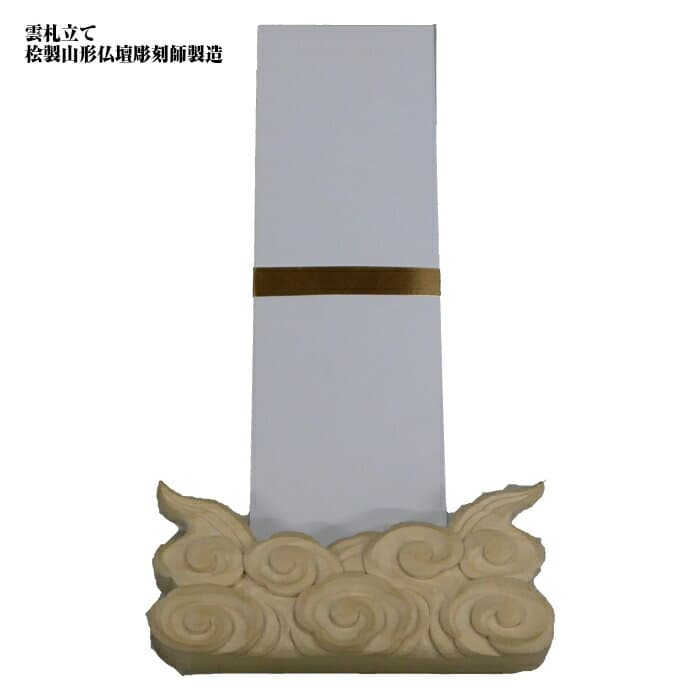
Yamagata Butsudan Hinoki Cloud Ofuda Stand
お札立て 雲 小 日本製 桧製 手造り 送料無料 メール便 手作り 山形仏壇 雲 神棚 お札立て モダン 彫刻 御札立 天然木 御札 置き型 お札入れ 新生活 ご祈祷札 賃貸
Smallすとう楽天市場店
Japanese name山形仏壇
In Yamagata City, altar makers divide the work into seven major processes, assemble the inner shrine without nails, and lay gold leaf in a room closed against any breeze.
Information last updated 114 days ago
3 imagesお札立て 雲 小 日本製 桧製 手造り 送料無料 メール便 手作り 山形仏壇 雲 神棚 お札立て モダン 彫刻 御札立 天然木 御札 置き型 お札入れ 新生活 ご祈祷札 賃貸
Smallすとう楽天市場店
First time buying on Rakuten? How residents in Japan order →
Yamagata butsudan comes into view through Yamagata City place names and workshop details. The Yamagata Prefecture Buddhist Altars Commerce and Industry Cooperative is based in Matsumicho, and a member shop in Tokamachi handles Buddhist altars, altar fittings, mikoshi, repainting, and repair. Approach one altar and the carved decoration, sturdy structure, and inner shrine stand out; step toward the workbench and the subject becomes seven processes, several months of labor, and thin gold leaf that will lift in a draft.
The geography of Yamagata butsudan begins with named places in Yamagata City: the cooperative contact point in Matsumicho, a member shop in Tokamachi, and the city listing that treats Yamagata butsudan as a local craft. Those names place the product family within a working circle of makers, shops, and an association in the city.
That circle covers Buddhist altars and fittings, mikoshi, and work such as altar repainting and repair. When the word tradition is used here, it means these concrete activities in Yamagata City: making altars, handling fittings, repairing surfaces, and keeping the Yamagata butsudan name connected to a producer community.
The predecessor of the Yamagata Prefecture Buddhist Altars Commerce and Industry Cooperative was organized in November 1911 as a group for Buddhist statues, mikoshi, and Buddhist altars; in February 1950 it took the current name. This timeline gives Yamagata butsudan a community history rooted in makers who once organized around statues, portable shrines, and altars together.
The continuity is concrete: a predecessor group in 1911, a renamed cooperative in 1950, and member shops that still handle altars, fittings, mikoshi, repainting, and repair. Those details explain how the product family has stayed attached to an organized craft community in Yamagata City.
Yamagata City introduces altar maker Yoshio Suzuki, who explains that Yamagata butsudan production is broadly divided into seven processes handled by different specialists, with one altar taking several months to complete. His description turns a finished altar back into time, sequence, and many hands.
The altars are described through fine workmanship, a solemn impression, and sturdy construction. Those qualities are tied to visible carving, structure, and the way seven processes meet before an altar is ready for a home interior.
Inside a Yamagata butsudan, the palace-like structure known as the kuden is one of the clearest features named by makers. It is assembled from wood without nails or adhesive, so the small architectural space inside the altar depends on joinery rather than metal fasteners or glue.
The kuden gives the altar’s sturdy impression a concrete form. Its wooden parts meet without nails or adhesive, and the inner space becomes a place where the viewer can read craft skill through structure as well as ornament.
Suzuki’s own work, the leafing and fitting process, comes at the end: gold leaf is applied to carved ornament. Because thin gold leaf will lift in even a slight breeze, the room is kept closed during finishing, even in summer.
Shinya Otsuki is also introduced as a Yamagata butsudan maker who trained in techniques including gold-leaf fitting and received traditional craftsperson recognition in 2019. The craft detail that remains in the room is precise: carved ornament, gold leaf, closed air, and the handwork of the final process.
Suzuki notes that fewer people now place Buddhist altars in their homes, while there is still demand for altars suited to the size and space of a residence and usable in both Japanese- and Western-style rooms. That brings present-day Yamagata butsudan into specific interiors: room size, tatami rooms, Western-style rooms, and the place a household leaves for an altar.
The supported use context is concrete and domestic. Makers respond to contemporary home layouts by considering how an altar can sit in different kinds of rooms, keeping the altar connected to the scale of a household interior.
Otsuki serves as vice director of the Yamagata Prefecture Buddhist Altars Commerce and Industry Cooperative, helps organize and run exhibitions, and is described as working for the spread of Yamagata butsudan, the vitality of the production area, and the training of successors. The maker’s role reaches beyond finishing an altar at the workbench; it also includes showing the work publicly and teaching the next hands.
Culture, in this setting, means practical action: exhibitions, technical learning, successor training, cooperative duties, and relationships among altar makers in Yamagata City. These actions give Yamagata butsudan a community context alongside the wood-joined kuden, gold-leaf finishing, repainting, and repair.
Yamagata butsudan is carried by Yamagata City place names, seven processes, several months of work, a nail-free wooden kuden, and gold leaf that must be handled away from wind. From the cooperative in Matsumicho to a member shop in Tokamachi, from Suzuki’s closed finishing room to Otsuki’s exhibitions and successor training, one altar is connected to a living division of craft labor and to the rooms where families still make space for it.
Compiled from public records and official sources; see the recognition links below. Details may change over time.
Where this product is officially registered, designated, or recognized in Japan.
Traditional craft
Designated a Traditional Craft (dentō kōgeihin) by Japan's Ministry of Economy, Trade and Industry.
Sources1
It is written as 山形仏壇 in Japanese. Search Rakuten and other Japanese sites with that spelling — the English name will not bring up the listings.
Yamagata Buddhist altars (Yamagata butsudan) is a Buddhist altar product family centered on Yamagata City and connected to the Yamagata Prefecture Buddhist Altars Commerce and Industry Cooperative. Production is broadly divided into seven processes handled by different specialists, and completing one altar takes several months.
Yamagata butsudan is listed as a craft of Yamagata City, and the Yamagata Prefecture Buddhist Altars Commerce and Industry Cooperative is based in Matsumicho, Yamagata City. The cooperative's predecessor was organized in November 1911 and took its current name in February 1950. The kuden inside a Yamagata butsudan is assembled from wood without nails or adhesive. The final leafing and fitting process applies gold leaf to carved ornament, and the room is closed because the thin leaf moves in a slight breeze.
An altar is chosen to match the size of the dwelling and the interior, including both Japanese- and Western-style rooms. Cooperative member shops also handle recoating and repair of Buddhist altars, and recoating and repair of mikoshi.
Keep craft pieces out of direct sunlight, damp, and sharp temperature swings, and store them where they won't knock against anything. Wood, bamboo, lacquer, and paper don't tolerate water — wipe any moisture off immediately. Specific care notes are on the listing.
Most options are shelf-stable, boxed, and travel well, so they suit gifting or bringing home. Confirm the final storage and delivery terms on the Rakuten listing.
On Rakuten: the shops listed here right now are すとう楽天市場店. We don't sell directly; purchase, payment, stock, and delivery are all handled on the Rakuten product page.