 2 images
Daimon Somen Hand-Stretched Somen Noodles
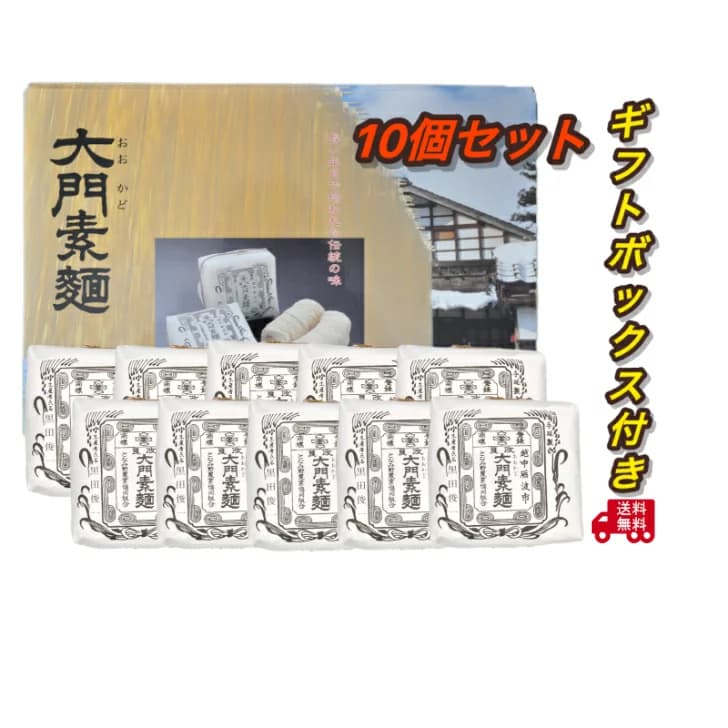
大門素麺 350g×10個入 ギフトボックス付き 手延べそうめん 富山特産 老舗の味 伝統製法 夏の定番 ギフトにもおすすめ 無添加麺 大門そうめん 丸まげそうめん 乾麺 ギフト お中元 おちゅうげん 中元
350g x 10 packs, gift box白山くろゆり商店本店
Japanese name大門素麺
In Tonami’s Okado district, wheat dough is kneaded with Shogawa water, twisted, stretched, dried in winter air, shaped into round coils, and wrapped in washi marked with the maker’s name.
Information last updated 21 days ago
2 images大門素麺 350g×10個入 ギフトボックス付き 手延べそうめん 富山特産 老舗の味 伝統製法 夏の定番 ギフトにもおすすめ 無添加麺 大門そうめん 丸まげそうめん 乾麺 ギフト お中元 おちゅうげん 中元
350g x 10 packs, gift box白山くろゆり商店本店
 3 images
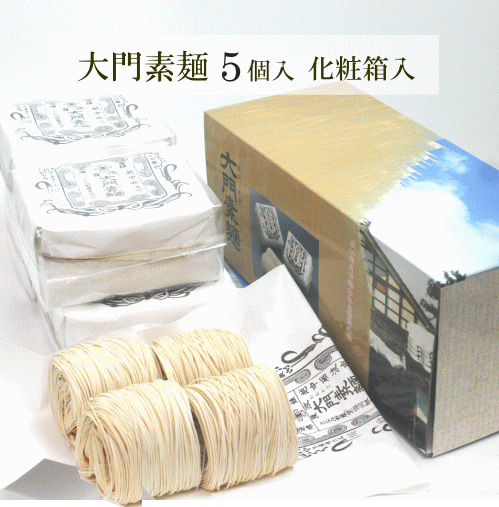
大門素麺(350g)5個入化粧箱【となみ野農業協同組合】各種お祝い事にも
350g x 5 packs, gift boxます寿司屋ヒロ助
5.0 / 3 reviews
 2 images
となみ野農業協同組合 大門素麺 350g 5個 大門素麵 そうめん 手延べ のどごし なめらか コシ 国産小麦 富山 北陸
350g x 5 packs北陸うまいもん屋
5.0 / 1 reviews
 2 images
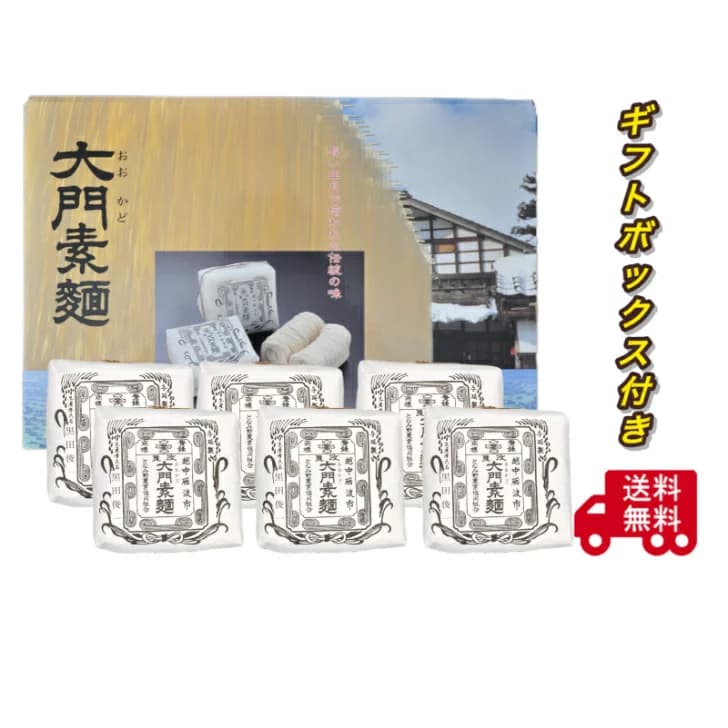
大門素麺 350g×6個入 ギフトボックス付き 手延べそうめん 富山特産 老舗の味 伝統製法 夏の定番 ギフトにもおすすめ 無添加麺 大門そうめん 丸まげそうめん 乾麺 ギフト お中元 おちゅうげん 中元
350g x 6 packs with gift box白山くろゆり商店本店
5.0 / 1 reviews
 3 images
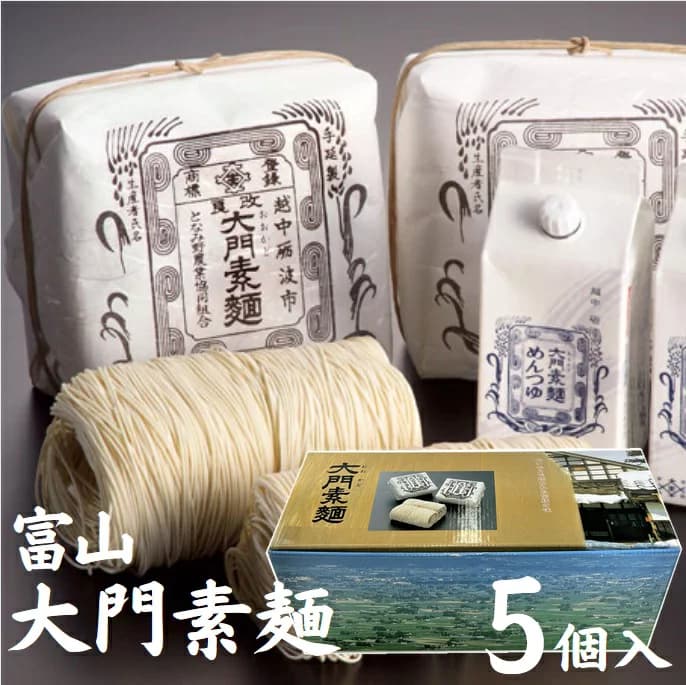
お中元におすすめ 「大門素麺 5個(化粧箱入)」長い年月で培われた富山県砺波の伝統の味 贈り物 ギフトにも
350g x 5 packs, presentation box百選横丁 楽天市場店
5.0 / 3 reviews
 3 images
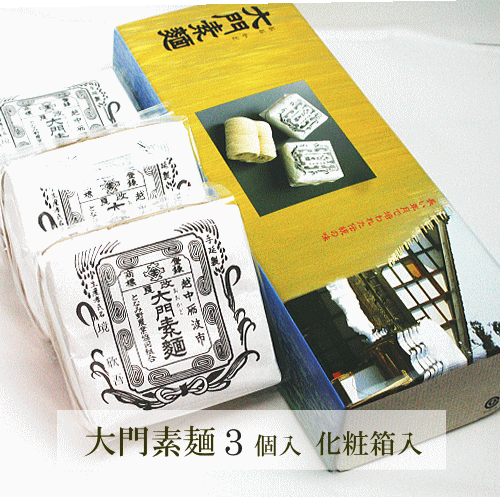
大門素麺(350g)3個入り化粧箱入り送料込【となみ野農業協同組合】 丸髷型のめずらしい形と素敵な包装が贈り物として人気。お世話になった人へのお礼の品に。
350g x 3 gift boxます寿司屋ヒロ助
4.3 / 8 reviews
 3 images
大門素麺(350g)2個入化粧箱 送料込【となみ野農業協同組合】丸髷型のめずらしい形と素敵な包装が贈り物として人気。お世話になった人へのお礼の品に。
350g x 2 packsます寿司屋ヒロ助
4.0 / 2 reviews
 3 images
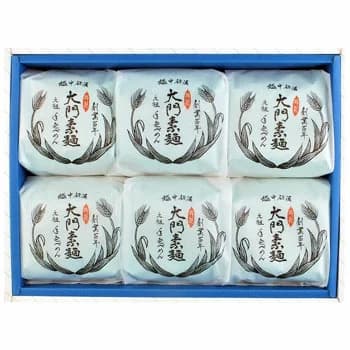
砺波名物「末永次八、特製大門素麺 6個入」
375g x 6 packs百選横丁 楽天市場店
5.0 / 2 reviews
First time buying on Rakuten? How residents in Japan order →
All 8 listings of this product on Rakuten, lowest price first.
| Listing | Price | Shop | Reviews | Open listing |
|---|---|---|---|---|
Okado Somen White Gift Box 350g x 2 packsLowest priceGift-ready | ¥2,950 | ます寿司屋ヒロ助 | 4.0 / 2 reviews | View on Rakuten → |
Okado Somen Noodles 350g x 3 gift boxMost reviewedGift-ready | ¥3,900 | ます寿司屋ヒロ助 | 4.3 / 8 reviews | View on Rakuten → |
Tonamino Agricultural Cooperative Daimon Hand-Stretched Somen 350g x 5 packs | ¥5,500 | 北陸うまいもん屋 | 5.0 / 1 reviews | View on Rakuten → |
Okado Somen Noodles 350g x 5 packs, gift boxGift-ready | ¥5,800 | ます寿司屋ヒロ助 | 5.0 / 3 reviews | View on Rakuten → |
Daimon Somen Noodles 350g x 5 packs, presentation boxGift-ready | ¥5,981 | 百選横丁 楽天市場店 | 5.0 / 3 reviews | View on Rakuten → |
Daimon Somen Hand-Stretched Somen Noodles 350g x 6 packs with gift boxGift-ready | ¥6,900 | 白山くろゆり商店本店 | 5.0 / 1 reviews | View on Rakuten → |
Suenaga Jihachi Special Daimon Somen 375g x 6 packs | ¥7,927 | 百選横丁 楽天市場店 | 5.0 / 2 reviews | View on Rakuten → |
Daimon Somen Hand-Stretched Somen Noodles 350g x 10 packs, gift boxGift-ready | ¥10,750 | 白山くろゆり商店本店 | View on Rakuten → |
Japanese · new tab
Okado Somen belongs to the Okado district of Tonami City in Toyama Prefecture. The district sits near the center of the Tonami Plain, a broad fan shaped by the Shogawa and Oyabe rivers, where water, farm work, and winter weather all enter the noodle’s shape. From October to March, makers knead wheat flour, salt, vegetable oil, and Shogawa water, then twist, stretch, hang, dry, cut, coil, and wrap the noodles by hand.
The name Okado Somen points to Tonami City’s Okado district. Around it lies the Tonami Plain, formed by the Shogawa and Oyabe rivers and known for dispersed farmhouses with sheltering groves. The finished noodle is not bundled straight; it is bent into a round marumage coil. Before boiling, the coil can be broken by hand, and the shape fits easily into a pot. That practical curve gives a local noodle a visible form before it becomes a bowl of cold somen, nyumen, or clear soup at home.
The basic ingredients are wheat flour, salt, and vegetable oil, with water from the Shogawa area worked into the dough. Makers knead repeatedly before the dough is twisted and stretched into thin strands. Tonami materials place the main production season from October to March, the coldest stretch of the year. The noodle’s firm bite begins with that simple mixture of wheat and water, then develops through repeated handling in winter conditions.
After repeated kneading, the dough is twisted, stretched, rested overnight, and hung on rods called hasa. Cold wind descending from the mountains dries the strands and tightens the texture. Before the noodles become fully dry, makers cut them by hand, form them into round coils, wrap them in washi, and let them dry for about ten more days. Some kneading has been mechanized, but the described work still centers on hand hanging, stretching, drying, shaping, and wrapping.
The arrival of the method in Okado is told through more than one route. One account places the beginning around 1848, when a medicine peddler from Okado learned somen methods associated with the Kaga domain and brought them home. Another description connects the technique with Takojima in Noto. Read carefully, both accounts place Okado Somen within late-Edo movement of noodle-making knowledge into a farming village, where the process settled into local winter work.
Okado Somen grew as off-season work for farming households. In the early Showa period, more than 60 households made it; as of January 2025, nine producers continued the work. The washi wrapper carries the producer’s name, turning each round coil into a named piece of household labor rather than an anonymous regional label. Local continuity also appears in restaurant use, preservation efforts, and visits by elementary and junior high school students in Tonami.
At the table, the round coil is usually broken by hand before boiling. The noodle is described as firm, smooth in the throat, and resistant to becoming soft in water. In a Toyama summer setting, it can be served cold with broth made from dried white shrimp; it is also used in warm nyumen and clear soup. The cultural weight of the noodle is concrete: Shogawa water in the dough, winter wind on the strands, a maker’s name on washi, and a household bowl at the end.
Okado Somen is easy to recognize before it is cooked: a round coil of thin noodles wrapped in washi and marked by a maker’s name. Behind that quiet form are Tonami’s river plain, the October-to-March production season, repeated twisting and stretching, cold mountain wind, and the shift from more than 60 early-Showa households to nine producers in January 2025. Its continuity is best read through these concrete details: wheat, Shogawa water, hasa rods, winter air, and the bowls in which the noodles are still eaten.
Compiled from public records and official sources; see the recognition links below. Details may change over time.
Where this product is officially registered, designated, or recognized in Japan.
Regional collective trademark
Registered as a Regional Collective Trademark with the Japan Patent Office.
Sources1
It is written as 大門素麺 in Japanese. Search Rakuten and other Japanese sites with that spelling — the English name will not bring up the listings.
Daimon somen is a hand-stretched somen from the Okado district of Tonami City, Toyama Prefecture. It is made with wheat flour, salt, vegetable oil, and Shogawa water, mainly from October to March.
More than 60 households made Daimon somen in the early Showa period, while nine producers remained as of January 2025. The process includes repeated kneading, twisting, stretching, overnight resting, hanging on hasa rods, and drying in cold winter wind. Before full dryness, the noodles are hand-cut, formed into round marumage coils, wrapped in washi, and dried for about ten more days. Each washi wrapper carries the maker's name and is used for midyear gifts.
It is eaten as a Toyama summer dish of cold noodles with dried white-shrimp broth. It is also used in warm nyumen and in clear soup. The round shape fits a pot and makes boiling easy after the noodles are broken by hand; they are sold in supermarkets and mainly eaten at home.
Storage varies by product — shelf-stable, refrigerated, or frozen — and is stated on the packaging and the Rakuten listing. Shelf-stable processed foods usually need refrigerating once opened and eating within a few days; chilled and frozen items go straight into storage on arrival. Treat the best-before date on the physical packaging as authoritative.
Most options are shelf-stable, boxed, and travel well, so they suit gifting or bringing home. Confirm the final storage and delivery terms on the Rakuten listing.
On Rakuten: the shops listed here right now are 白山くろゆり商店本店, ます寿司屋ヒロ助, 北陸うまいもん屋, 百選横丁 楽天市場店. We don't sell directly; purchase, payment, stock, and delivery are all handled on the Rakuten product page.