 2 images
Nagasaki Goto Hand-Stretched Udon
【マラソン限定クーポン配布中】長崎五島うどん 五島手延うどん(業務用)2000g【 乾麺 五島 手延べ 海塩 コシ 喉ごし 業務用 お徳用 2kg 】
2 kg bulk packにっぽん津々浦々
4.9 / 9 reviews
Japanese name五島手延うどん
In Shinkamigoto, Nagasaki, Goto Tenobe Udon takes shape through wheat dough, salt water, camellia oil, sea salt, and ago flying-fish broth, staying close to island meals and graduation farewells.
Information last updated 119 days ago
2 images【マラソン限定クーポン配布中】長崎五島うどん 五島手延うどん(業務用)2000g【 乾麺 五島 手延べ 海塩 コシ 喉ごし 業務用 お徳用 2kg 】
2 kg bulk packにっぽん津々浦々
4.9 / 9 reviews
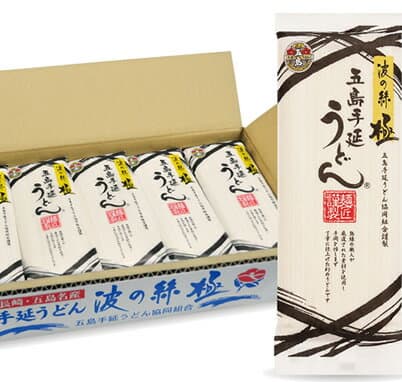
五島手延うどん波の絲「極」ドーンと30袋
200g x 30 bags五島手延うどん協同組合楽天市場店
5.0 / 4 reviews
First time buying on Rakuten? How residents in Japan order →
Goto Tenobe Udon starts in Shinkamigoto in Nagasaki’s Goto Islands. The cooperative is based in Arikawago, and the noodle belongs to a Kamigoto setting of fishing, farm work, and preserved food made from familiar ingredients such as wheat flour and salt water. Its old nickname, “phantom udon,” came from long production time and limited output, so the phrase points to slow work before it points to mystery.
Arikawago in Shinkamigoto is a concrete starting point for Goto Tenobe Udon. The Goto Tenobe Udon cooperative is located there, within the Kamigoto area of Nagasaki’s Goto Islands. For island residents moving between fishing and farm work, dried noodles made from familiar ingredients became practical preserved food. In that setting, the noodle is anchored by a town name, a producer community, wheat flour, salt water, and a food that could wait for daily meals.
The hand-stretched method begins with dough made from wheat flour, salt, and water. The dough is coated with edible vegetable oil or starch, twisted, gradually stretched, then moved through hand pulling, hanging, and drying. Those steps separate hand-stretched dried noodles from cut dried udon: the defining labor is the sequence of twisting, pulling, hanging, and drying that turns dough into strands.
The taste world around Goto Tenobe Udon is tied to island materials. Nagasaki product material connects the noodle with camellia oil pressed from camellia seeds on the islands, sea salt associated with the Goto-nada waters, and ago, or flying fish, for broth and related products. These materials do not create one fixed recipe for every item, but they do give the noodle a grounded setting: glossy strands, a smooth throat-feel, and the aroma of flying-fish broth.
The phrase “phantom udon” came from a practical limit: careful production took a long time, and output stayed small. Read beside the process, the nickname becomes a clue to labor. Wheat flour and salt water had to be worked, coated, twisted, stretched, pulled by hand, hung, and dried before the noodle could become preserved food for Kamigoto households.
At a Shinkamigoto graduation-season event, the cooperative gave sets of Goto Tenobe Udon and ago-dashi soup to students leaving Kamigoto High School, the Kamigoto branch classroom of Sasebo Special Needs School, and Nakagoto High School. The scene included 137 graduates at Kamigoto High School, one graduate at the branch classroom, and 43 graduates at Nakagoto High School. Student Daiki Uramoto described simply seasoned Goto udon as delicious, familiar, and a hometown taste, placing the noodle between departure and memory.
A leading local theory connects Goto Tenobe Udon to older maritime routes. During the era of Japanese missions to Tang China, Kamigoto served as a port of call, and a noodle-making method resembling sakumen still found in the Yantan area of Zhejiang, China, may have reached the islands through that route. The careful reading is a historical thread: Kamigoto links its noodle memory to Nara- and Heian-period sea travel and hand-stretched noodle techniques.
The strongest shape of Goto Tenobe Udon is concrete: Arikawago in Shinkamigoto, wheat flour, salt water, hand-stretched dried noodles, camellia oil, Goto-nada sea salt, ago broth, and a graduation gift carried by students leaving the island. From the mixing bowl to the drying rack, the noodle joins Kamigoto’s materials, handwork, and everyday meals.
Compiled from public records and official sources; see the recognition links below. Details may change over time.
Where this product is officially registered, designated, or recognized in Japan.
Regional collective trademark
Registered as a Regional Collective Trademark with the Japan Patent Office.
Sources1
It is written as 五島手延うどん in Japanese. Search Rakuten and other Japanese sites with that spelling — the English name will not bring up the listings.
Goto Tenobe Udon is a hand-stretched dried noodle associated with Kamigoto and Shinkamigoto in Nagasaki's Goto Islands. Its method begins with wheat flour and salt water, then uses oil or starch, twisting, gradual stretching, hand pulling, hanging, and drying. The noodle's local setting includes camellia oil, Goto-nada sea salt, and ago flying-fish broth, and Shinkamigoto graduation seasons have included udon and ago broth as a hometown gift.
Goto Tenobe Udon's cooperative is located in Arikawago, Shinkamigoto. Goto Tenobe Udon was once called "phantom udon" because its long production time limited output. Goto Tenobe Udon was a familiar food for island residents busy with fishing and farm work, valued as a tasty preserved food made from accessible ingredients. The Nagasaki cooperative and related council have worked on shared quality standards, recognition, sales promotion, and local industry stability.
Goto Tenobe Udon can be eaten hot or cold, including as a cold noodle dish in summer, often paired with ago-dashi broth. The Shinkamigoto cooperative has given sets of Goto Tenobe Udon and ago-dashi soup to local high-school graduates as they leave Kamigoto. Faster-cooking versions exist, including a three-minute noodle and an instant ago-dashi udon.
Storage varies by product — shelf-stable, refrigerated, or frozen — and is stated on the packaging and the Rakuten listing. Shelf-stable processed foods usually need refrigerating once opened and eating within a few days; chilled and frozen items go straight into storage on arrival. Treat the best-before date on the physical packaging as authoritative.
Most options are shelf-stable, boxed, and travel well, so they suit gifting or bringing home. Confirm the final storage and delivery terms on the Rakuten listing.
On Rakuten: the shops listed here right now are にっぽん津々浦々, 五島手延うどん協同組合楽天市場店. We don't sell directly; purchase, payment, stock, and delivery are all handled on the Rakuten product page.