 3 images
Lemnos MIKI Shogawa Hikimono Kiji Zelkova Clock
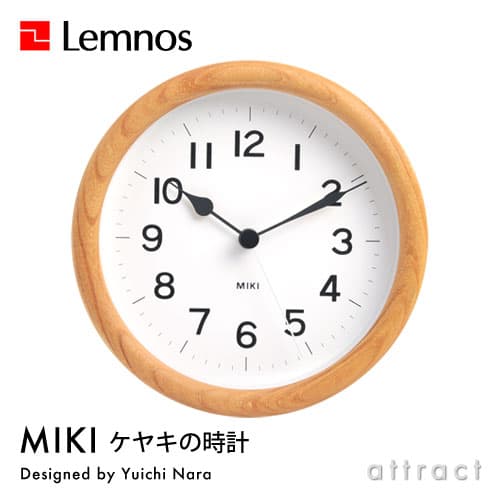
レムノス Lemnos タカタ MIKI ミキ ケヤキの時計 NY12-06 Φ148mm 木枠 スイープムーブメント デザイン:奈良雄一 秒針有 壁掛け時計 置き時計 ウォールクロック 日本製 富山 庄川挽物木地 贈り物 ギフト 【RCP】【smtb-KD】
φ148mmアトラクト
5.0 / 4 reviews
Japanese name庄川挽物木地
In Toyama’s Shogawa area, Hida mountain logs, keyaki and tochi boards, slow drying and horizontal lathes meet in tea trays, saucers, bowls and confectionery vessels.
Information last updated yesterday
3 imagesレムノス Lemnos タカタ MIKI ミキ ケヤキの時計 NY12-06 Φ148mm 木枠 スイープムーブメント デザイン:奈良雄一 秒針有 壁掛け時計 置き時計 ウォールクロック 日本製 富山 庄川挽物木地 贈り物 ギフト 【RCP】【smtb-KD】
φ148mmアトラクト
5.0 / 4 reviews
First time buying on Rakuten? How residents in Japan order →
Shogawa Hikimono Kiji begins with timber moving through a river district. Logs cut in the Hida mountains were once sent down the Shogawa and stored around Shogawa; from that movement of wood came boards, drying stacks, horizontal lathes and everyday vessels whose annual rings remain visible on the table.
The craft’s place begins with mountains, river current and timber yards. From the Edo period to the early Showa years, logs cut in the Hida mountains were moved along the Shogawa and stored in the Shogawa area; an earlier late-sixteenth-century timber-floating account also links the river to wood movement for the Kaga domain.
That supply supported wood-base work in Shogawa. One account places the local industry from the late Edo years, while another describes craftspeople making lathe-turned wood bases as a business in Shogawa in the later nineteenth century. Read together, they point to a workshop field shaped over time by river timber, with current major production areas named in Toyama as Takaoka, Tonami and Nanto.
Shogawa Hikimono Kiji is not a single object name. It refers to wood bases and vessels shaped from selected lumber through horizontal-lathe turning, drying, finishing cuts and hand polishing. The practical range includes tea trays, tea saucers, tea chests, tea caddies, confectionery vessels, bowls, small plates and serving bowls.
Those object names keep the work close to use. A saucer sits under a tea bowl, a confectionery vessel or serving bowl enters the table setting, and a small plate brings the turned surface near the hand. The family’s outline is clearest in these usable wooden forms rather than in a decorative label.
The listed woods include tochi, keyaki, pine, cherry, inu-enju, mulberry, katsura, sen and ginkgo, or lumber with equivalent qualities. Keyaki and tochi appear especially often: keyaki is hard and weighty, with lively grain, while tochi resists deformation and works well as a base for lacquerware.
Before a piece reaches the lathe, a craftsperson judges the outside of the log and chooses material for the intended object and dimensions. The choice is concrete: hardness, weight, grain, deformation risk, lacquer compatibility and the eventual size of a tray, bowl or serving vessel all matter before the first rough cut.
After sawing, boards are stacked and left to dry naturally for about six months to one year so the wood is less likely to warp. Only then does the work move toward shaping: the blank is cut slightly larger than the marked circle, placed on the horizontal lathe and rough-turned with tools such as the zenmai kanna.
Moisture control continues after the first turning. Rough-turned material is dried by heat to about 8 percent moisture, then exposed to outside air until it returns to about 12 percent. Finish turning uses the horizontal lathe with karakasa kanna and usuba tools, followed by hand polishing; the calm surface of a tray or bowl depends on this sequence as much as on the spinning lathe.
A visible signature of Shogawa turning comes from cutting across the wood so the vessels run parallel to the wood’s vessels and grain structure. Annual rings appear in varied shapes across tea trays, saucers, bowls and confectionery vessels; the pattern is not applied ornament but the wood revealed by cross-grain turning.
Unpainted shirakiji keeps that surface open to time and handling. Its color and gloss shift with air, use and the surrounding environment, and rubbing with tea grounds wrapped in cloth is described as one way the tone and shine can deepen over months. The table surface changes through wood, touch and repeated use.
Continuity becomes specific in the profile of one named wood-base craftsperson. Tadada Takuji entered the trade in 1948 and remembered streets in Shogawa where lathe sounds came from workshops. He worked under a master for 17 years, and later his son worked in the same workshop.
That biography should stay at the scale of one workshop, not stand for every maker in Shogawa. Its concrete details still matter: the 1948 start, the 17 years of apprenticeship, father and son at the same benches, and the remembered sound of lathes in the town.
Shogawa Hikimono Kiji gathers Toyama’s river timber history, keyaki and tochi boards, six months to a year of drying, horizontal-lathe cuts and hand polishing into tea trays, saucers, bowls and confectionery vessels. Its rings come from cross-grain turning, and its unpainted surfaces deepen through air, time and use. A Shogawa vessel carries wood movement, moisture control and handwork into an everyday table object.
Compiled from public records and official sources; see the recognition links below. Details may change over time.
Where this product is officially registered, designated, or recognized in Japan.
Traditional craft
Designated a Traditional Craft (dentō kōgeihin) by Japan's Ministry of Economy, Trade and Industry.
Sources1
It is written as 庄川挽物木地 in Japanese. Search Rakuten and other Japanese sites with that spelling — the English name will not bring up the listings.
Shogawa turned woodwork is a Toyama wood-base and vessel family from the Shogawa river timber district, where logs cut in the Hida mountains were moved and stored. Keyaki and tochi are the central materials; boards dry naturally for six months to one year before rough turning, moisture adjustment, finish turning and hand polishing. Cross-grain turning gives varied annual-ring patterns to tea trays, saucers, bowls and confectionery vessels, and unpainted shirakiji changes color and gloss with air, time, use and environment.
Major production areas include Takaoka, Tonami and Nanto. The family's beginning is described broadly, from the late Edo period to the later nineteenth century, since sources phrase the timing differently. The product range includes tea trays, tea saucers, confectionery vessels, bowls, tea chests, tea caddies, small plates and serving bowls. Keyaki is hard and weighty with distinctive grain, while tochi resists deformation and works well as a lacquer base.
Tea utensils can vary in dimensions by school, so it helps to check the practices of the relevant tea tradition before use. Unpainted shirakiji can be rubbed with tea grounds wrapped in cloth to deepen its color and shine over time. Tochi wood bases are suited to lacquer finishing, with raw lacquer applied repeatedly after the white wood base is completed.
Keep craft pieces out of direct sunlight, damp, and sharp temperature swings, and store them where they won't knock against anything. Wood, bamboo, lacquer, and paper don't tolerate water — wipe any moisture off immediately. Specific care notes are on the listing.
Most options are shelf-stable, boxed, and travel well, so they suit gifting or bringing home. Confirm the final storage and delivery terms on the Rakuten listing.
On Rakuten: the shops listed here right now are アトラクト. We don't sell directly; purchase, payment, stock, and delivery are all handled on the Rakuten product page.