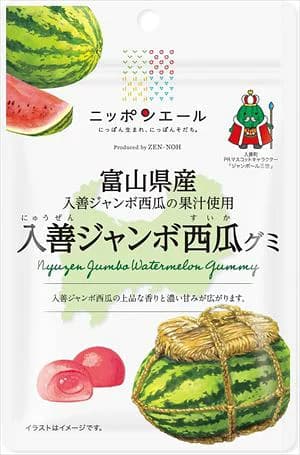
Zen-Noh Toyama Nyuzen Jumbo Watermelon Gummies
送料無料 全農 富山県産入善ジャンボ西瓜グミ 40g×10袋 ネコポス
40g x 10 bags御用蔵 大川
Japanese name入善ジャンボ西瓜
In Toyama’s Nyuzen Town, sandy shallow soil, spring water, careful spacing, and rice straw shape a long oval watermelon made for midsummer slices.
Information last updated 38 days ago
送料無料 全農 富山県産入善ジャンボ西瓜グミ 40g×10袋 ネコポス
40g x 10 bags御用蔵 大川
First time buying on Rakuten? How residents in Japan order →
Nyuzen Jumbo Watermelon grows in Nyuzen Town in northeastern Toyama Prefecture. The Kurobe River alluvial fan gives the area sandy, shallow soil with low water retention, a useful condition for watermelon because too much moisture can interfere with long growth. In fields supported by local spring water and rice-field rotation, the fruit develops into a dark-striped, rugby-ball-like oval. Around mid-July to early August, its red flesh is cut for a crisp, juicy sweetness that stays refreshing despite the fruit’s size.
Nyuzen Town sits in northeastern Toyama, where the Kurobe River has formed a broad alluvial fan. Much of the soil is sandy and shallow, with low water retention, and many local rice fields can be used as watermelon fields. Those conditions matter because the fruit needs a long growing period to become heavy and large, while watermelon is vulnerable to excess moisture. The place behind Nyuzen Jumbo Watermelon is therefore concrete: drained fan soil, abundant spring water, and fields that can move between rice and melon cultivation.
The fruit is known for a rugby-ball-like oval shape, a dark rind, and clear stripes. Typical weights are described at about 17 to 19 kilograms, with local descriptions also using about 18 kilograms; ordinary large watermelons are cited at about 7 to 9 kilograms. Size does not replace eating quality: the flesh is red and juicy, with a sweet aroma, crisp texture, and a clean sweetness that spreads in the mouth.
Growers leave at least 60 centimeters between plants so the fruit has room to enlarge. Each plant is thinned to two fruit or fewer, concentrating nutrients in a small number of watermelons instead of many. The crop is grown on its own roots and uses the Nyuzen Jumbo variety or a variety with equivalent traits, a set of choices tied to the long oval form, large size, and refreshing taste.
As the fruit grows heavier, rice straw is used as shade to prevent sunburn on the rind. A field that has carried the crop is then rested for at least six years to reduce problems from repeated cultivation. Tradition here is practical work in the field: straw placed over the fruit, a long rest for the soil, and thinning that leaves only a few melons to receive the plant’s strength.
The watermelon’s weight also shapes how it is handled after harvest. San-dawara, a woven rice-straw pad, is tied above and below the long oval fruit to protect it from damage. The straw is more than a surface look: it is a local material fitted to a heavy crop, and it helps explain why the watermelon has become recognizable at summer events and in ochugen gift customs.
Large watermelon cultivation in the Kurobe River fan area reaches back to around 1887, and production in Nyuzen began around 1897. In 1909 the fruit came to be called Kurobe Suika, after the Kurobe River; in 1971 a local producer association was formed, and in 1982 the group name changed with the move toward Nyuzen Jumbo Suika. Production under the current name began around 1983. The later geographical indication adds context for the production area, method, and weight boundary, while the lived continuity remains in the town’s fields and producer community.
The harvest season falls from July into August, placing Nyuzen Jumbo Watermelon in the middle of Toyama’s summer. It appears in local festivals and events, and its size and straw-wrapped presence suit ochugen gift customs. At the table, the important detail is still the cut fruit: red flesh, plenty of juice, crisp bite, and a refreshing sweetness held inside a melon that may weigh several times more than an ordinary large watermelon.
Nyuzen Jumbo Watermelon is rooted in specific conditions rather than vague regional romance: the sandy soil of the Kurobe River fan, spring water in Nyuzen Town, rice-field rotation, wide spacing, fruit thinning, straw shade, and san-dawara protection. Its long oval body and 17-to-19-kilogram scale make it visually memorable, but its red juicy flesh and crisp sweetness keep the giant fruit grounded as food for midsummer sharing.
Compiled from public records and official sources; see the recognition links below. Details may change over time.
Where this product is officially registered, designated, or recognized in Japan.
It is written as 入善ジャンボ西瓜 in Japanese. Search Rakuten and other Japanese sites with that spelling — the English name will not bring up the listings.
Nyuzen Jumbo Watermelon is a long oval watermelon grown in Nyuzen Town, Toyama Prefecture, on the Kurobe River alluvial fan. The fruit is usually described at about 17 to 19 kilograms, with a dark striped rind, red juicy flesh, crisp texture, and refreshing sweetness. Growers space plants at least 60 centimeters apart, thin each plant to two fruit or fewer, and shade the fruit with rice straw.
The alluvial fan of the Kurobe River gives the growing area its sandy shallow soil and local spring water. The fruit is long and oval like a rugby ball, with a dark rind and clear stripes. Typical weights of about 17 to 19 kilograms are noticeably larger than the 7 to 9 kilograms cited for ordinary large watermelons. Cultivation includes own-root growing and field rests of at least six years after harvest, along with the spacing and thinning practices used for the fruit.
The watermelon is often used for ochugen and other summer gift occasions, since its large size, distinctive shape, and straw wrapping suit gift giving and handling. It is also used in local festivals and events in Nyuzen Town, where it has long been treated as a seasonal presence in summer. Harvest and shipping run from July to early or mid August, when the flesh is red, juicy, crisp, and refreshingly sweet, suited to fresh eating in midsummer.
Fresh produce doesn't keep, so start with the grower's note in the box. Most fruit ripens best at room temperature and is at its most fragrant when it is ready to eat; refrigerate only once it is cut or fully ripe, and eat it soon after. Chilling too early stalls ripening and flattens the flavour. Follow the listing and the enclosed note for the specific variety.
Most options are shelf-stable, boxed, and travel well, so they suit gifting or bringing home. Confirm the final storage and delivery terms on the Rakuten listing.
On Rakuten: the shops listed here right now are 御用蔵 大川. We don't sell directly; purchase, payment, stock, and delivery are all handled on the Rakuten product page.