 2 images
Yae Nougei Akakubi Onnayama Daikon Seeds
赤首女山大根 2dl袋 大根 ダイコン だいこん ヤエ育成 【八江農芸 種 たね タネ】【通常5倍 5のつく日はポイント10倍対象外商品ポイント3倍固定商品】
2dl bag全国種苗出荷センター
Japanese name女山大根
In Nishitaku-machi, Taku City, a basin below Hachimandake, Onnayama, and Tokurendake grows a large red-neck daikon tied to river water, basalt-derived soil, and winter kitchens.
Information last updated 119 days ago
2 images赤首女山大根 2dl袋 大根 ダイコン だいこん ヤエ育成 【八江農芸 種 たね タネ】【通常5倍 5のつく日はポイント10倍対象外商品ポイント3倍固定商品】
2dl bag全国種苗出荷センター
First time buying on Rakuten? How residents in Japan order →
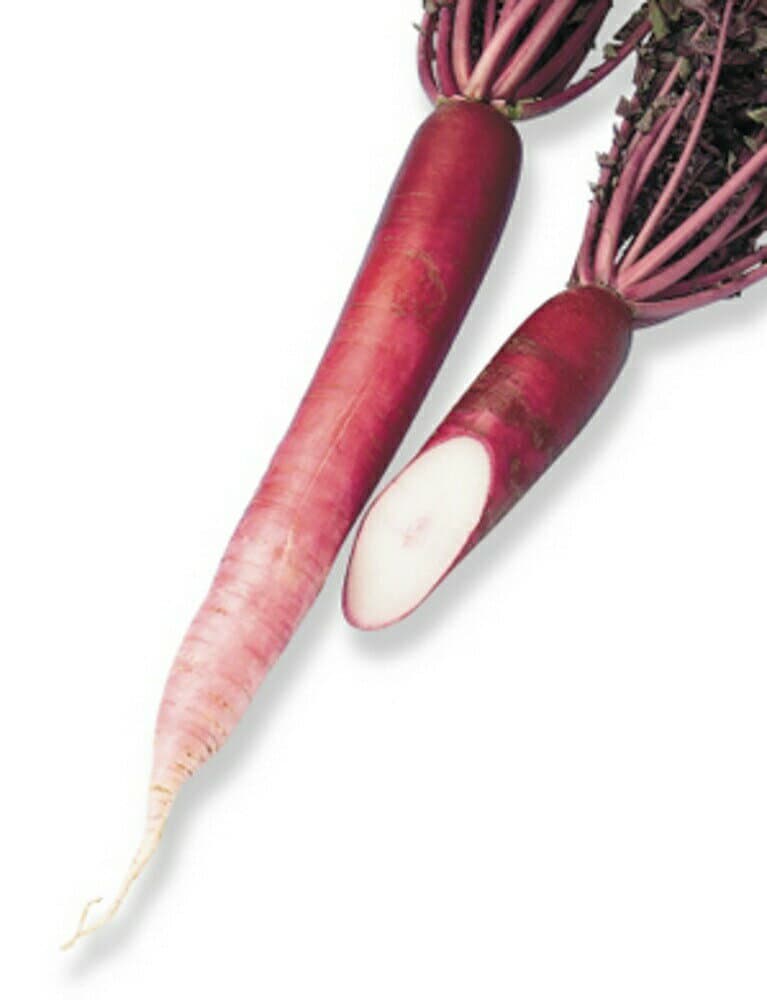
Onnayama Daikon grows in Nishitaku-machi, Taku City, Saga Prefecture. The basin has the headwaters of the Ushizu River and well-drained basalt-derived soil, conditions suited to a deep-rooting daikon that dislikes excess moisture. Its mature root is red-purple, commonly 4 to 5 kg and sometimes over 10 kg, yet the flesh stays dense, resists pithiness, and holds its shape in simmered dishes. Those concrete traits place the vegetable in winter meals, school lunches, and local gatherings rather than in a vague regional label.
The growing area of Nishitaku-machi sits among Hachimandake, Onnayama, also called Funayama, and Tokurendake. Around the basin, the headwaters of the Ushizu River make water accessible, while basalt-derived soil drains well. For a daikon that sends its root downward and does poorly in overly wet ground, those named mountains, river headwaters, and soil conditions explain the place connection in practical terms.
Onnayama Daikon is a red-neck daikon containing anthocyanin, which gives the root its red-purple color. Mature roots are often 4 to 5 kg, and larger ones can exceed 10 kg. Size does not make the flesh loose: the root is described as dense, slow to become pithy, and higher in sugar content than common green-neck daikon. It is valued in simmered dishes, soups, and dressed preparations because the flesh does not break down easily during cooking.
The name Onnayama Daikon is tied to cultivation around Onnayama in Nishitaku-machi. The vegetable was grown from the Edo period and was once presented to the Nabeshima family of the Saga domain. An 1847 local chronicle, Tankyu Yushi, also carries the name, and Kusaba Haisen took it up in poems and paintings. The name therefore points to fields, a mountain, and specific local memory rather than to color alone.
In modern times, the root's large size no longer fit standard distribution channels, and cultivation shrank to small household plots. Early Showa-era conversion to crops such as mandarin oranges also pushed the old form close to disappearance. From the late 1980s, local participants, agricultural institutions in Saga, and Taku City worked from remaining seed, repeating crossing and selection for nearly ten years. By 2020, about 30 producers were growing roughly 10 tons.
The work continues through seed collected and stored in the production area and cultivation kept within that same area. If natural crossing makes traits unstable, original stock held by the Saga Prefecture Agricultural Research Center can be used for seed renewal. The later protected-name framework turns those boundaries into practical rules: roots are sorted by leaf-on harvest weight of at least 2 kg, red-purple color over roughly half the root, a long cylindrical form, and the absence of rot, cavities, or wounds reaching the flesh.
The main season runs from mid-December to late February. During that winter period, Taku City's school lunch center uses Onnayama Daikon in menus, bringing the red-purple root into everyday bowls. A local Onnayama Daikon festival began in 2007, and a quality fair was revived as producers worked on quality; together, lunches, the festival, and the fair connect fields with school meals and local exchange.
Onnayama Daikon can be read through concrete things: the three mountains around Nishitaku-machi, the headwaters of the Ushizu River, basalt-derived soil, remaining seed, red-purple color, dense flesh, and winter dishes that hold the root's shape. It once retreated to household plots, then returned through years of selection. Its continuity is measured in seeds kept in the area, roots sorted for color and form, and bowls served in Taku during the cold months.
Compiled from public records and official sources; see the recognition links below. Details may change over time.
Where this product is officially registered, designated, or recognized in Japan.
It is written as 女山大根 in Japanese. Search Rakuten and other Japanese sites with that spelling — the English name will not bring up the listings.
Onnayama Daikon is a red-purple red-neck daikon from Nishitaku-machi, Taku City, Saga Prefecture. The basin, ringed by Hachimandake, Onnayama, and Tokurendake, has well-drained basalt soil near Ushizu River headwaters, suited to deep-rooting daikon. Roots weigh 4-5 kg, sometimes over 10 kg, with dense flesh that resists pithiness, useful in simmered dishes, soups, and dressed preparations. Once nearly lost, it was revived from the late 1980s using saved seed and selection, reaching about 30 producers and roughly 10 tons by 2020.
The vegetable was cultivated from the Edo period and was once presented to the Nabeshima family of the Saga domain. The root contains anthocyanin. Seed is collected, stored, and cultivated within the production area, and roots are sorted by weight, color, long cylindrical shape, and soundness. Onnayama Daikon is connected to a local festival that began in 2007 for exchange with consumers.
Its dense flesh, higher sugar content, and resistance to breaking down make it useful in simmered dishes (nimono), soups, and dressed dishes (aemono). It appears on school lunch center menus in Taku City from mid-December to late February, the shipping season. Roots meeting the main size, color, shape, and soundness standards but with flesh-reaching wounds or broken surfaces may be shipped for processing after the damaged parts are removed.
Storage varies by product — shelf-stable, refrigerated, or frozen — and is stated on the packaging and the Rakuten listing. Shelf-stable processed foods usually need refrigerating once opened and eating within a few days; chilled and frozen items go straight into storage on arrival. Treat the best-before date on the physical packaging as authoritative.
Most options are shelf-stable, boxed, and travel well, so they suit gifting or bringing home. Confirm the final storage and delivery terms on the Rakuten listing.
On Rakuten: the shops listed here right now are 全国種苗出荷センター. We don't sell directly; purchase, payment, stock, and delivery are all handled on the Rakuten product page.