 3 images
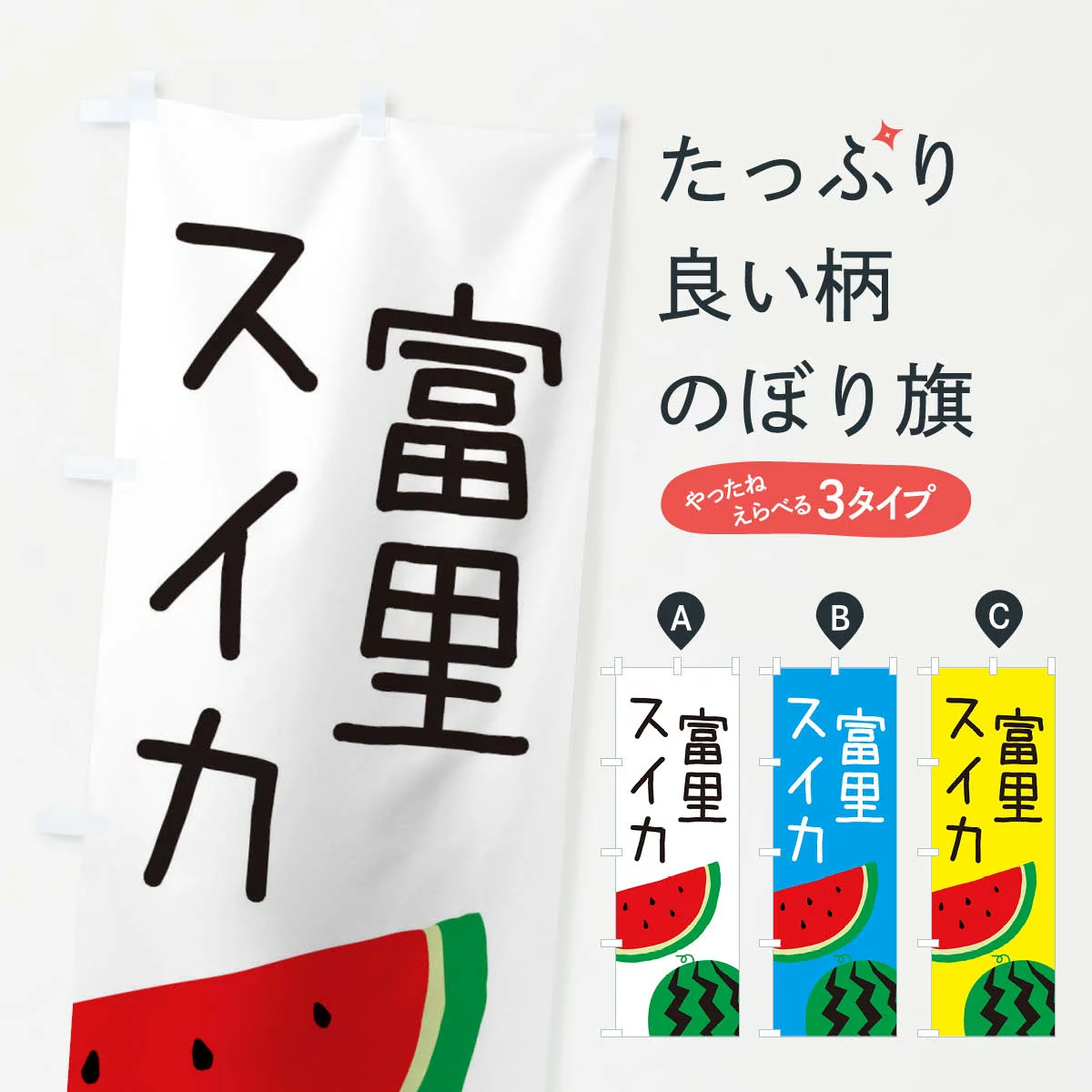
Tomisato Watermelon Nobori Flag
【ネコポス送料360】 のぼり旗 富里スイカのぼり EK72 スイカ・西瓜 グッズプロ 【名入れできます+1017円】
EK72 designグッズプロ
Japanese name富里スイカ
In inland Chiba, Tomisato’s well-drained Kanto loam, light volcanic-ash soil, and day-night temperature swings shape a crisp early-summer watermelon.
Information last updated 20 days ago
3 images【ネコポス送料360】 のぼり旗 富里スイカのぼり EK72 スイカ・西瓜 グッズプロ 【名入れできます+1017円】
EK72 designグッズプロ
First time buying on Rakuten? How residents in Japan order →
Tomisato Suika grows in Tomisato City on Chiba’s Hokuso Plateau. The inland fields are tied to well-drained Kanto loam, light volcanic-ash soil, and wide shifts between daytime and nighttime temperatures, conditions associated locally with clear sweetness and a crisp bite. Its season moves from winter or early-spring seeding through nursery houses, transplanting, tunnel temperature work, fruit turning, and trial cutting before the mid-May to mid-July shipping period.
Tomisato City sits inland in Chiba Prefecture, on the Hokuso Plateau. The growing area is described through light volcanic-ash soil and well-drained Kanto loam, with a larger temperature gap between day and night than coastal parts of the prefecture. Local descriptions connect those field conditions with watermelon sweetness and a crisp texture.
Watermelon favors heat, dryness, and strong sunlight, while damp conditions are harder on the plant. Tomisato’s main season overlaps with the rainy weeks of early summer, so growers use greenhouse and tunnel systems to manage temperature and wet weather as fruit moves toward the mid-May to mid-July shipping window.
Watermelon cultivation in Tomisato traces back to 1926, when one farm in the Tokura district planted 0.5 hectares. The following year, three farms cultivated 0.85 hectares together, and joint growing and joint shipping began early enough to influence how the local crop was received in markets.
In 1935, the Tomisato Village Watermelon Cultivation Association was formed. In 1936, planted area reached 120 hectares, and watermelons produced in Tomisato were presented to the Imperial Household. After wartime contraction, cultivation resumed in earnest around 1948 and expanded across Tomisato during the 1950s.
Tomisato’s watermelon area is not carried by one farm alone. The early pattern of shared cultivation and shared sales led into common cultivation practices, joint inspection and shipping, designated markets, and planned shipping, giving many fields a shared rhythm for quality and timing.
Soil disease once made it difficult to grow watermelon repeatedly in the same fields. Grafting developed in the 1950s made repeated cultivation possible, and later tunnel, mulch, and intensive vine-training systems gave growers finer control over roots, vines, flowers, and fruit position.
The Tomisato Suika season begins with seed. Seeds are sown in winter or early spring, seedlings are raised in nursery houses, and young plants are transplanted into fields; the path from sowing to harvest takes about half a year. In the field, vine training methods such as four vines with two fruit or three vines with one fruit help balance vine growth and fruit load.
After flowering, pollination is often handled with bees. Under tunnels, growers open and close covers to manage temperature, thin fruit so selected melons can mature, and turn each fruit two or three times for more even rind color. Before harvest, trial cutting in the field checks sugar level and ripeness.
The shipping peak arrives in June, and the early-summer field calendar becomes visible in town. The Tomisato watermelon festival and the Tomisato Suika Road Race are both held during this high season, placing the crop in streets, gathering spaces, and the memory of visitors as well as in the fields.
Tomisato City enacted a watermelon ordinance in 2021, and the city is commonly associated with watermelon. Behind that civic association are concrete seasonal scenes: large watermelons from May to July, greenhouse and tunnel work during rainy weeks, and June events built around the harvest period.
Tomisato City describes ripe watermelon through visible and tactile signs: a fresh stem cut, a heavy feel, clear stripes, vivid flesh color, black seeds, and a thin rind. These details bring the field’s ripeness work into the moment before a melon is cut open.
Growers also check ripeness directly before harvest. Trial cutting in the field confirms sugar level and maturity, and fruit is then sorted by size and grade. On the table, the core impression of Tomisato Suika remains its sweetness and crisp, shattering texture.
Tomisato Suika is shaped by inland Hokuso Plateau fields, volcanic-ash and Kanto loam soils, a small Tokura planting in 1926, cooperative shipping habits, and greenhouse and tunnel work through the rainy season. From mid-May to mid-July, those conditions gather in an early-summer watermelon; in June, festivals and a road race carry the field season back into the streets of Tomisato.
Compiled from public records and official sources; see the recognition links below. Details may change over time.
Where this product is officially registered, designated, or recognized in Japan.
Regional collective trademark
Registered as a Regional Collective Trademark with the Japan Patent Office.
Sources1
It is written as 富里スイカ in Japanese. Search Rakuten and other Japanese sites with that spelling — the English name will not bring up the listings.
Tomisato watermelon (Tomisato Suika) is a watermelon product family from Tomisato City on Chiba's Hokuso Plateau. Inland fields with well-drained Kanto loam, light volcanic-ash soil, and day-night temperature differences are linked to its sweetness and crisp texture. Cultivation began in 1926 with a 0.5-hectare planting in the Tokura district, later developing through cooperative cultivation, joint shipping, grafting, and greenhouse and tunnel methods. The main season runs from mid-May to mid-July, peaking in June with local events.
In 1927, three farms jointly cultivated 0.85 hectares, an early example of cooperative cultivation and joint shipping. The Tomisato Village Watermelon Cultivation Association formed in 1935, and Tomisato-grown watermelons were presented to the Imperial Household in 1936. Grafting developed in the 1950s made repeated watermelon cultivation possible in the same fields. Tomisato Suika cultivation includes nursery raising, transplanting, pollination, tunnel temperature management, fruit thinning, fruit turning, and trial cutting before harvest.
Large watermelons are available from early May to mid-July, matching the hot-weather period when watermelon is eaten chilled and shared. Tomisato City lists signs for choosing a ripe watermelon, including a fresh stem cut, a heavy feel, a clear striped pattern, vivid flesh color, black seeds, thin rind, and sugar levels measured by refractometer. June's peak season includes the Tomisato watermelon festival and the Tomisato Suika Road Race, giving visitors a chance to encounter the crop in its production area.
Fresh produce doesn't keep, so start with the grower's note in the box. Most fruit ripens best at room temperature and is at its most fragrant when it is ready to eat; refrigerate only once it is cut or fully ripe, and eat it soon after. Chilling too early stalls ripening and flattens the flavour. Follow the listing and the enclosed note for the specific variety.
Most options are shelf-stable, boxed, and travel well, so they suit gifting or bringing home. Confirm the final storage and delivery terms on the Rakuten listing.
On Rakuten: the shops listed here right now are グッズプロ. We don't sell directly; purchase, payment, stock, and delivery are all handled on the Rakuten product page.