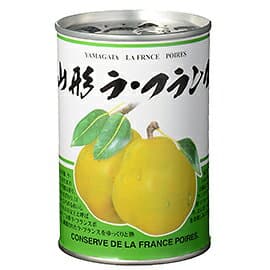
Yamagata La France Pears in Heavy Syrup
山形ラ・フランス / 425g【 富澤商店 公式 】
425g can富澤商店 楽天市場店
Japanese name山形ラ・フランス
Yamagata La France is harvested around mid-October, then precooled at about 2-5°C and ripened at room temperature until its aroma and melting flesh appear.
Information last updated 120 days ago
山形ラ・フランス / 425g【 富澤商店 公式 】
425g can富澤商店 楽天市場店
First time buying on Rakuten? How residents in Japan order →
In Yamagata Prefecture, La France is not a pear meant to be eaten straight from the tree. The Western pear is harvested around mid-October, placed into cool storage, then ripened at room temperature; when wrinkles form near the stem, the fragrance grows stronger, and the flesh near the stem gives slightly, the fruit is ready for the table.
Yamagata accounts for about 80 percent of Japan’s La France production, and producing areas in the prefecture use sales-start reference dates to align the timing of fruit that has been harvested, precooled, ripened, and shipped. The name is also protected under Japan’s GI system; in plain terms, that status connects the Yamagata place name with a shared production area, producer community, and quality boundary.
The orchard calendar begins with pruning and training from February to March, when growers remove extra branches so sunlight and air can move through the tree. From April to July, bud thinning, blossom thinning, and fruit thinning reduce clusters toward one fruit per flower bud, and in June and July growers manage vigorous watersprouts so leaves and branches do not block the fruit.
La France does not turn red like an apple, so harvest timing depends on other signs. Around the mid-October harvest period, Yamagata producing areas look at remaining starch, fruit firmness, days after full bloom, and that year’s growing conditions, and they hold meetings to judge the best harvest window for the season.
After harvest, La France is precooled at about 2-5°C to slow respiration; ZEN-NOH Yamagata describes a roughly seven-day precooling step, while Tendo’s La France Center offers one concrete example of low-temperature storage, sorting, and ripening in a shared facility. Once the fruit returns to room temperature, starch changes into sugar and the pear moves toward its soft, fragrant eating point.
Yamagata’s promotion council brings together JA groups, markets, shipping organizations, producers, and the prefecture around production and sales work. Tendo City is described as the largest La France producing city within Yamagata, and its La France Center handles fruit from registered orchards through precooling, sorting, and ripening; for the premium Super La France subset, transmitted-light sensors judge sugar, firmness, and ripeness.
Ripeness can be read from a drying stem, wrinkles around the stem, stronger aroma, and slight softness near the stem. For cutting, the regional association recommends quartering the fruit before peeling, removing the core, then peeling thinly; chilling it for two to three hours before eating suits the ripe texture, and fully ripe halves can be wrapped, frozen, naturally thawed, and eaten with a spoon like sherbet.
The La France cultivar originated in France in 1864, reached Japan around Meiji 36, and came to Yamagata in the early Taisho period. It was once used as a pollinizer for Bartlett pears, then began attracting fresh-fruit attention around Showa 45; today, pruning in February, harvest in October, precooling, ripening, and table cutting give the cultivar a clear autumn rhythm in Yamagata.
Yamagata La France is shaped by a sequence that refuses to hurry: late-winter pruning, spring and summer thinning, mid-October harvest, cold storage, room-temperature ripening, and the final signs around the stem. The waiting before the first cut is part of how this Western pear reaches its fragrant, soft peak.
Compiled from public records and official sources; see the recognition links below. Details may change over time.
Where this product is officially registered, designated, or recognized in Japan.
Geographical Indication (GI)
Registered under Japan's Geographical Indication Protection System, run by the Ministry of Agriculture, Forestry and Fisheries.
Sources1
It is written as 山形ラ・フランス in Japanese. Search Rakuten and other Japanese sites with that spelling — the English name will not bring up the listings.
Yamagata La France pears is a Western pear product family tied to Yamagata Prefecture, which accounts for about 80 percent of Japan's La France production. The fruit is harvested around mid-October, precooled at about 2-5°C, then ripened at room temperature until fragrance and soft flesh develop.
The La France cultivar originated in France in 1864, reached Japan around Meiji 36, and was introduced to Yamagata in the early Taisho period. Tendo City is described as the largest La France producing city within Yamagata, and the La France Center handles precooling storage, sorting, and ripening. Harvest timing is judged by remaining starch, firmness, days after full bloom, and growing conditions. Orchard work includes February-March pruning, April-July bud, blossom, and fruit thinning, and June-July watersprout management.
The fruit is not eaten immediately after harvest; after precooling and ripening it develops a soft, melting texture and rich fragrance. Readiness is checked by aroma, a withering stem, wrinkles around the stem, and gentle softness near the stem. A regional association recommends cutting into quarters without peeling first, removing the core area, then peeling thinly; chilling 2-3 hours before eating is suggested. Fully ripe fruit can be halved, wrapped, frozen, naturally thawed, and eaten with a spoon as a sherbet-like preparation.
Storage varies by product — shelf-stable, refrigerated, or frozen — and is stated on the packaging and the Rakuten listing. Shelf-stable processed foods usually need refrigerating once opened and eating within a few days; chilled and frozen items go straight into storage on arrival. Treat the best-before date on the physical packaging as authoritative.
Most options are shelf-stable, boxed, and travel well, so they suit gifting or bringing home. Confirm the final storage and delivery terms on the Rakuten listing.
On Rakuten: the shops listed here right now are 富澤商店 楽天市場店. We don't sell directly; purchase, payment, stock, and delivery are all handled on the Rakuten product page.