 3 images
AJI PROJECT Aji Stone Natural Stone Paperweight
【AJI PROJECT】自然石 ペーパーウェイト ペーパーウエイト 癒やし 自然 石 香川県 アート インテリア 雑貨【庵治石】(1個)paper weight
1 piece暮屋*くらや
5.0 / 1 reviews
Japanese name庵治石
On the Seto Inland Sea side of Takamatsu, Aji stone moves from quarry face to workshop through fine crystals, grain reading, splitting, sawing, chisel work, and a polished surface known for its floating pattern.
Information last updated 120 days ago
3 images【AJI PROJECT】自然石 ペーパーウェイト ペーパーウエイト 癒やし 自然 石 香川県 アート インテリア 雑貨【庵治石】(1個)paper weight
1 piece暮屋*くらや
5.0 / 1 reviews
 3 images
AJI PROJECT / ブックエンド ROCK END S - 細目 ロックエンド 庵治石 自然石 インテリア 雑貨 置物 ブックスタンド 卓上 倒れない 丈夫 伸縮 おしゃれ オブジェ モダン 本立て 本立 石 倒れ ない スタンド 本 ブック エンド
S, fine grainジュエリー/ファッション EHS
5.0 / 1 reviews
 3 images
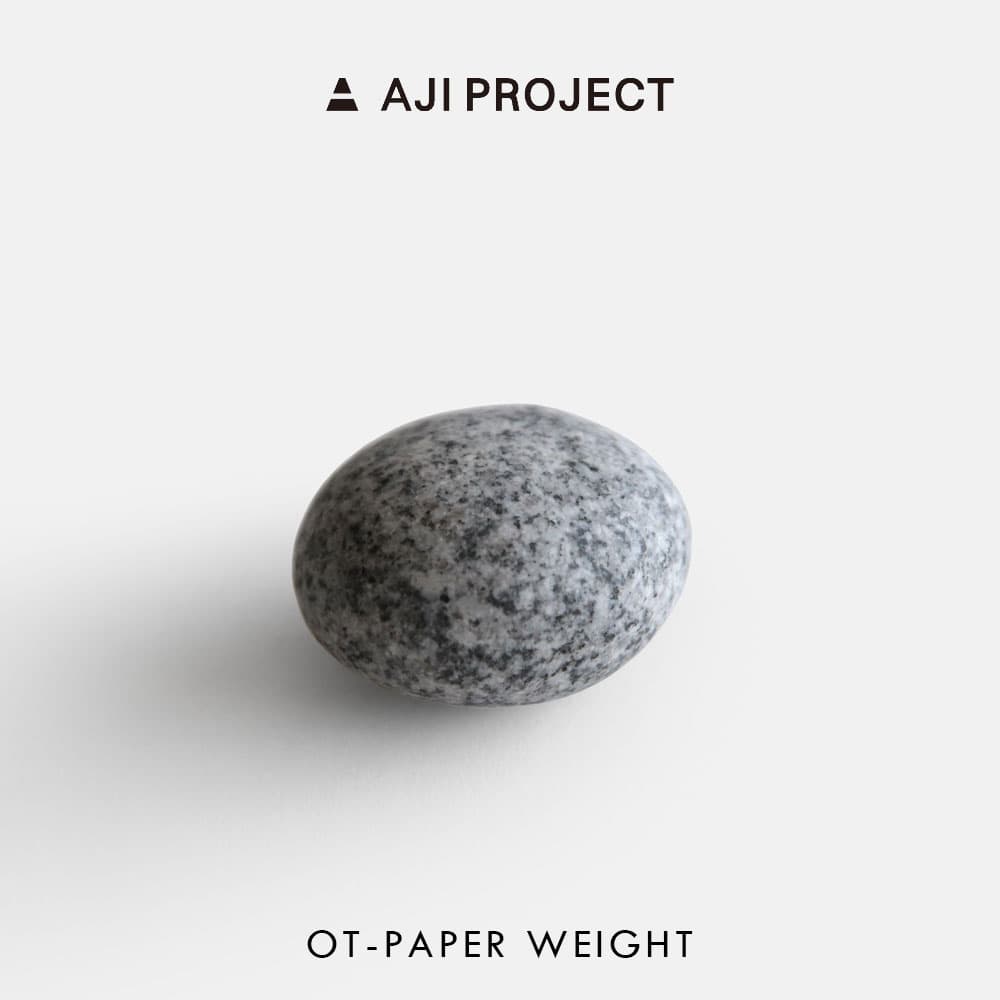
AJI PROJECT アジプロジェクト / OT-PAPER WEIGHT|ペーパーウェイト KORO コロ 庵治石 自然石 石材 オブジェ デザインストーン シンプル モダン ギフト|116854
approx. W80 x D50 x H30 mmB.L.W
First time buying on Rakuten? How residents in Japan order →
Aji stone belongs to the Aji-cho and Mure-cho areas of Takamatsu, Kagawa, on a peninsula facing the Seto Inland Sea. The name is tied to stone quarried there and to processed objects such as gravestones and lanterns made there from that stone. Described as fine-grained granite or granodiorite, it carries small crystals of quartz, feldspar, mica, and black mica. In the workshop, those mineral facts become practical decisions: where to split, how to read the grain, where to saw, and how the final surface should feel under the hand.
The production area for Aji stone centers on Aji-cho and Mure-cho in Takamatsu, Kagawa. Aji-cho is presented as a peninsula town at the northern edge of Shikoku, facing the Seto Inland Sea, while local stoneworking groups link the industry to both Aji and Mure. The regional collective trademark sets a practical boundary around the name: stone from these towns, and processed items such as gravestones and lanterns made there from that stone.
Aji stone is described as a fine-grained granite or granodiorite with small crystals of quartz, feldspar, mica, and black mica. Its dense grain is associated with hardness, low water absorption, and resistance to weathering and discoloration. For stoneworkers, those traits are not decorative language; they define how thin a detail can be carved, how a surface can be polished, and how the stone behaves when cut.
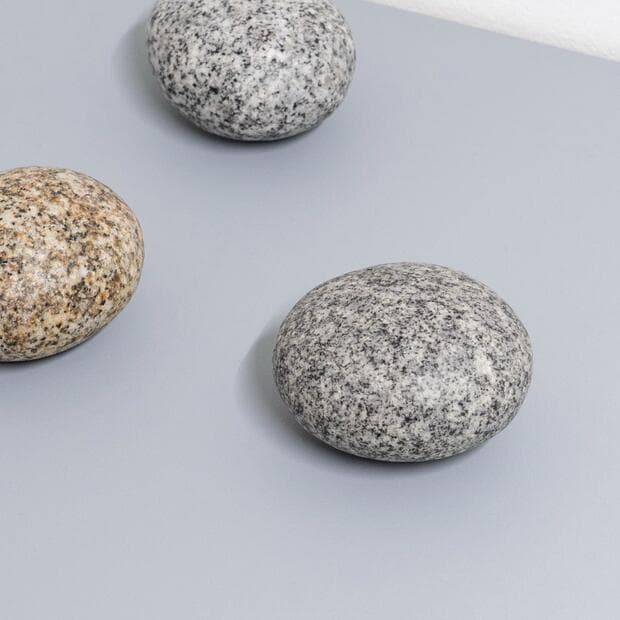
Some Aji stone shows a surface effect called “fu ga uku” after polishing. The descriptions compare it to a mottled, moistened-looking pattern and to a double kasuri-like surface across the stone. On gravestones, monuments, or building material, that effect gives the polished face a fine movement of light and dark rather than a flat gray plane.
The work begins at the quarry. Rock plates are taken by blasting, large pieces are removed through large splitting, and smaller splitting brings the stone closer to the size needed for later work. Each stage depends on reading the grain, because a hard stone must be opened and shaped with attention to its natural direction before it can be sawed or carved cleanly.
In the workshop, stone is cut by saw according to drawings, then shaped in detail with chisels. The fine, hard grain of Aji stone supports this close work, while the stoneworker keeps checking the material by sight and touch. A finished edge, polished plane, or carved line is judged through the hand as well as the eye.
Aji stone appears in gravestones, stone monuments, lanterns, stone carving, memorial works, exterior art, and architectural materials. These uses differ in scale, but each asks the stoneworker to balance hardness, grain direction, cut surface, and polish. A lantern, a gravestone face, and a building stone all carry the same material discipline into different settings.
Accounts of Aji stone trace quarrying and processing back to the late Heian period, with stone said to have been shipped as far as Kyoto. The present production area is also described through cooperatives, member workshops, stonework examples, workshop routes, fairs, and craft events. Continuity here rests in named towns and repeatable tasks: quarrying, splitting, cutting, polishing, carving, and handing stonework from one workshop stage to another.
Aji stone is grounded in a narrow place: Aji-cho and Mure-cho in Takamatsu. Its character comes through just as clearly in the material itself, from fine crystals and hardness to the polished “fu ga uku” surface. Between quarry and workshop, the stone is split, read, sawed, carved, polished, and checked by touch, carrying the Aji and Mure stoneworking area into gravestones, lanterns, sculpture, monuments, and architectural stone.
Compiled from public records and official sources; see the recognition links below. Details may change over time.
Where this product is officially registered, designated, or recognized in Japan.
Regional collective trademark
Registered as a Regional Collective Trademark with the Japan Patent Office.
Sources1
It is written as 庵治石 in Japanese. Search Rakuten and other Japanese sites with that spelling — the English name will not bring up the listings.
Aji granite is a stone material and product family from Aji-cho and Mure-cho in Takamatsu, Kagawa. It is described as fine-grained granite or granodiorite with small quartz, feldspar, mica, and black mica crystals. Some polished pieces show the mottled, double kasuri-like surface pattern called “fu ga uku.”
Accounts trace Aji stone quarrying and processing to the late Heian period and mention shipment as far as Kyoto. The name covers stone from Aji-cho and Mure-cho and processed items made there from that stone, including gravestones and lanterns. Production includes blasting, large splitting, small splitting, grain reading, sawing to drawings, chisel work, and touch-based finishing.
Aji stone is used for gravestones, stone monuments, and related memorial stonework. It is also used for lanterns, stone carving, monuments, and exterior art. It is used in modern architecture, and rusty-colored stone has drawn attention as a building material in recent years.
Keep craft pieces out of direct sunlight, damp, and sharp temperature swings, and store them where they won't knock against anything. Wood, bamboo, lacquer, and paper don't tolerate water — wipe any moisture off immediately. Specific care notes are on the listing.
Most options are shelf-stable, boxed, and travel well, so they suit gifting or bringing home. Confirm the final storage and delivery terms on the Rakuten listing.
On Rakuten: the shops listed here right now are 暮屋*くらや, ジュエリー/ファッション EHS, B.L.W. We don't sell directly; purchase, payment, stock, and delivery are all handled on the Rakuten product page.