 2 images
Tomoe Hokkaido Shikomi White Grain Miso
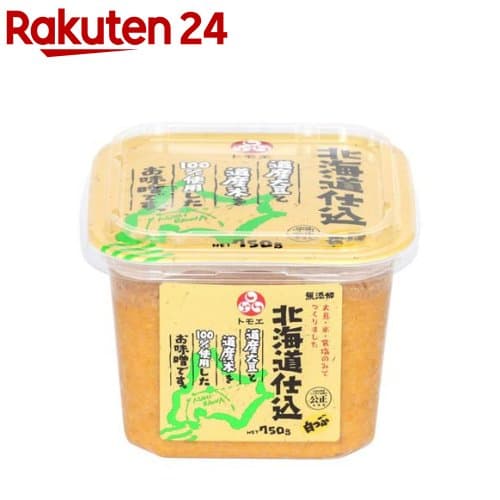
トモエ 北海道仕込み 白つぶ(750g)【トモエ】[基礎調味料 みそ汁 北海道味噌 大豆 朝食 和食]
750 g楽天24
4.2 / 34 reviews
Japanese name北海道味噌
Miso, soy sauce & fermented seasonings overview
Meiji-era migration, early production in Sapporo, and makers in Asahikawa, Abashiri, Hakodate, Yakumo, Otofuke, and other towns show how Hokkaido miso took shape through northern water, temperature, and humidity.
Information last updated 126 days ago
2 imagesトモエ 北海道仕込み 白つぶ(750g)【トモエ】[基礎調味料 みそ汁 北海道味噌 大豆 朝食 和食]
750 g楽天24
4.2 / 34 reviews
First time buying on Rakuten? How residents in Japan order →
Hokkaido miso begins with movement. In the Meiji period, settlers from many parts of Japan brought home-region tastes to Hokkaido. Early miso came from Honshu; after a government-run factory was established in Sapporo, miso breweries in Hokkaido gradually increased, and local production grew with them. The regional shape of Hokkaido miso is grounded in concrete conditions: a Sapporo production point, breweries across the island, and repeated adjustments to northern water, air temperature, and humidity.
In the Meiji period, settlers carried different food tastes from across Japan into Hokkaido. Early miso was supplied from Honshu, then a government-run factory was set up in Sapporo, after which the number of miso breweries in Hokkaido gradually increased and Hokkaido-made miso also increased. The early route is tangible: people moved north, miso moved with them, Sapporo became a production point, and local brewing began to widen from that base.
Methods inherited from Honshu did not transfer smoothly to Hokkaido at first. The local water, air temperature, and humidity differed, and miso made by conventional methods did not initially produce a pleasing result in the northern climate. Brewers repeated trials and searched for a method suited to Hokkaido. The place-specific character is practical: water enters production, cool air and humidity shape fermentation conditions, and the method has to answer the land around it.
After those repeated adjustments, Hokkaido miso is described as high quality, simple in flavor, and broadly liked. The supported sensory point is restrained: clean simplicity, not elaborate tasting notes beyond what the family material says. The cooperative also places miso within familiar Japanese eating, including miso soup, so the flavor belongs to bowls, soup, everyday seasoning, and the brewery conditions that made it possible.
Hokkaido miso is connected to more than one municipality. The cooperative member list names makers and brands in Sapporo, Asahikawa, Abashiri, Hakodate, Yakumo, Otofuke, and other places, with addresses also appearing in Obihiro, Kuriyama, Kunneppu, Honbetsu, Kamishihoro, Takasu, Shimizu, and Chitose. Read as a map, the list shows an island-wide community: urban breweries, northern and eastern districts, Tokachi-area towns, and southern Hokkaido all connected through miso and soy-sauce production.
The name Hokkaido Miso has a formal boundary in Japan, with the Hokkaido Miso Shoyu Manufacturers Cooperative tied to that boundary. In everyday terms, the boundary points back to tangible anchors: the cooperative address in Sapporo, member makers across Hokkaido, the shift from Honshu supply to local production, and brewery methods adjusted to water, temperature, and humidity. The name gathers place, producer community, and northern production conditions under one shared term.
The continuity of Hokkaido miso rests in specific details: Meiji-era settlers carrying regional tastes, miso first arriving from Honshu, Sapporo production helping local breweries increase, and brewers testing methods under northern natural conditions. When the miso is used in soup or everyday seasoning, its cultural meaning is concrete: migration, brewing, local water, and climate remain present in a familiar food.
Hokkaido miso can be followed from an early Sapporo production point to makers in Asahikawa, Abashiri, Hakodate, Yakumo, Otofuke, and other municipalities. Its shape comes from Meiji-era movement, Honshu supplies, and the growth of Hokkaido breweries. Northern water, temperature, and humidity pushed brewers to adjust their work, leaving a clean and simple flavor in daily use.
Compiled from public records and official sources; see the recognition links below. Details may change over time.
Where this product is officially registered, designated, or recognized in Japan.
Regional collective trademark
Registered as a Regional Collective Trademark with the Japan Patent Office.
Sources1
It is written as 北海道味噌 in Japanese. Search Rakuten and other Japanese sites with that spelling — the English name will not bring up the listings.
Hokkaido miso is a regional miso family associated with Hokkaido. In the Meiji period, settlers brought food tastes from across Japan; early miso came from Honshu, and after a government-run factory was established in Sapporo, Hokkaido breweries increased. Brewers adjusted production to local water, temperature, and humidity, reaching a clean, simple flavor. Cooperative members are listed in Sapporo, Asahikawa, Abashiri, Hakodate, Yakumo, Otofuke, and other municipalities.
Hokkaido miso's Meiji-era background includes settlers bringing regional tastes, early miso supplied from Honshu, and more Hokkaido breweries after a government-run factory was established in Sapporo. The supported production distinction is adjustment to Hokkaido water, air temperature, and humidity, rather than a dossier-wide fixed ingredient formula. Hokkaido miso is described as high quality with a simple flavor that gained broad appeal. The Hokkaido Miso Shoyu Manufacturers Cooperative appears in the national miso federation's Hokkaido regional structure, with an address in Sapporo's Chuo ward.
Hokkaido miso is used in miso soup as an everyday seasoning. It appears in home cooking as part of Hokkaido's regional food traditions, which trace back to Meiji-era settlers. Visitors to Hokkaido can taste the local miso as part of regional tourism.
Storage varies by product — shelf-stable, refrigerated, or frozen — and is stated on the packaging and the Rakuten listing. Shelf-stable processed foods usually need refrigerating once opened and eating within a few days; chilled and frozen items go straight into storage on arrival. Treat the best-before date on the physical packaging as authoritative.
Most options are shelf-stable, boxed, and travel well, so they suit gifting or bringing home. Confirm the final storage and delivery terms on the Rakuten listing.
On Rakuten: the shops listed here right now are 楽天24. We don't sell directly; purchase, payment, stock, and delivery are all handled on the Rakuten product page.