 2 images
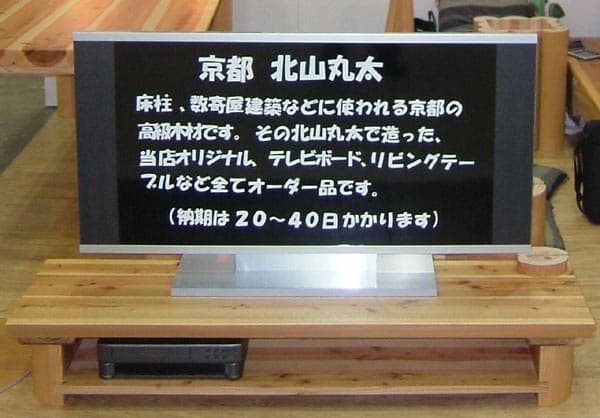
Kyoto Ichiyama Original Kitayama Maruta Custom TV Stand
京都市やまオリジナル北山丸太家具 別注オーダーTVボード 190cm幅まで【送料無料】 【smtb-k】 【ky】 【家具】【京都−市やま家具】 【RCP】
up to W190 x D41 x H35 cm京都ー市やま 楽天市場店
Japanese name北山丸太
In Kyoto's northwestern mountains, Kitayama cedar is pruned, peeled, and sand-polished into smooth round logs used in tea rooms, tokonoma posts, homes, furniture, and public interiors.
Information last updated 120 days ago
2 images京都市やまオリジナル北山丸太家具 別注オーダーTVボード 190cm幅まで【送料無料】 【smtb-k】 【ky】 【家具】【京都−市やま家具】 【RCP】
up to W190 x D41 x H35 cm京都ー市やま 楽天市場店
 2 images
京都北山丸太家具 別注オーダーTVボード240cm幅まで国産品【送料無料】【smtb-k】【ky】 【家具】【京都−市やま家具】 【RCP】
up to 240 cm wide京都ー市やま 楽天市場店

京都市やまオリジナル北山丸太家具 別注オーダーダイニングテーブル幅190cmまで【送料無料】 【smtb-k】 【ky】 【家具】【京都−市やま家具】 【RCP】
W190 x D80 x H70 cm京都ー市やま 楽天市場店
First time buying on Rakuten? How residents in Japan order →
Kitayama maruta begins in Kyoto's northwestern mountain area, especially around Nakagawa in Kita Ward. Kitayama cedar is repeatedly pruned, peeled, processed, and sand-polished into round logs whose surface remains visible: smooth to the touch, glossy in the light, and curved with the shape of the trunk. Across about 600 years of use, the material has been tied to tea rooms, sukiya architecture, and tokonoma posts, while also appearing today in homes, furniture, school interiors, and public buildings.
The production setting for Kitayama maruta is the Kitayama forestry area in northwestern Kyoto City, with Nakagawa in Kita Ward as its center. The material carries a local shape made of mountain slopes, cedar trees, branch pruning, peeling, and polishing work. Before the log enters a room, its story is already grounded in that cedar-growing area.
Kitayama cedar production in this area reaches back about 600 years, around the Muromachi period. That span does not appear as a date on the finished log; it remains in straight trunks, round profiles, and pale polished cedar skin. When a Kitayama maruta stands indoors, it brings the Nakagawa mountain work into human scale.
Kitayama maruta is made by peeling and processing Kitayama cedar. The family includes forms such as migaki maruta, jinko shibori maruta, tennen de-shibori maruta, menkawa-bashira, and taruki. Their surface expression and making methods differ, but each form keeps the cedar surface visible rather than hiding it inside a wall.
The work includes branch pruning, hon-shikomi preparation, rough bark removal, fine peeling, and sand polishing. Those steps move a tree from the mountain into an architectural or interior scale. Branches are managed, bark is removed, and the surface is refined until the curve of the log can become part of a tea room, home, or piece of furniture.
The gloss of Kitayama maruta begins with forest care and is completed through surface finishing. Repeated branch pruning helps create dense wood, and the finished material is known for a smooth, glossy skin with resistance to drying cracks. These traits suit an interior material placed where people can see grain, roundness, and surface at close range.
The long continuity of the material has a practical form: pruning, peeling, sand polishing, and visible use inside rooms. For a person entering the space, the clearest signs are the pale cedar surface, the rounded trunk line, and the smoothness that can be understood by sight and touch.
Kitayama maruta has long been connected with tea rooms and sukiya architecture. In rooms shaped by chanoyu, a post is close to the eye and hand, so wood grain, roundness, and touch matter. Tokonoma posts and guest-room columns gave polished Kitayama cedar a place where the surface could be appreciated directly.
Named Kyoto buildings give this use a concrete setting. Katsura Imperial Villa, Shugakuin Imperial Villa, and Shimabara Sumiya stand as sukiya examples using Kitayama maruta, while Daitokuji and Kinkakuji also belong to Kyoto examples connected with the material. The names matter because they place the polished cedar log inside rooms where exposed wood carried meaning.
Kitayama maruta now reaches beyond the tokonoma post. In homes, it appears as living-room accent posts and stair handrails; in furniture, it brings the cedar surface into daily contact. Public buildings and school interiors also use Kitayama cedar materials, including a municipal junior high school music room where boards retain natural edge surfaces.
In contemporary rooms, the material speaks through surface and distance. A handrail, a piece of furniture, a school room, or a public building can bring people close to grain, curve, gloss, and touch. Cedar raised around Nakagawa remains present as wood made for people to see at human scale.
Kitayama maruta follows a clear path: Kitayama cedar from the Nakagawa area of northwestern Kyoto is repeatedly pruned, peeled, processed, and sand-polished into a round log for visible use. It belongs to tea rooms, sukiya architecture, and tokonoma posts, and it also appears in homes, furniture, schools, and public buildings. Across those settings, the material speaks first through cedar grain, roundness, smooth skin, and gloss.
Compiled from public records and official sources; see the recognition links below. Details may change over time.
Where this product is officially registered, designated, or recognized in Japan.
Regional collective trademark
Registered as a Regional Collective Trademark with the Japan Patent Office.
Sources1
It is written as 北山丸太 in Japanese. Search Rakuten and other Japanese sites with that spelling — the English name will not bring up the listings.
Kitayama maruta is a polished round-log product made from Kitayama cedar in northwestern Kyoto, especially around Nakagawa in Kita Ward. The cedar is repeatedly pruned, peeled, processed, and sand-polished to create a smooth, glossy, dense surface that resists drying cracks. It has about 600 years of use in tea rooms, sukiya architecture, tokonoma posts, and present-day homes, furniture, schools, and public buildings.
Kitayama cedar production has about 600 years of continuity, reaching back around the Muromachi period. Production steps include branch pruning, hon-shikomi preparation, rough bark removal, fine peeling, and sand polishing. Repeated branch pruning helps create dense wood. Forms named under Kitayama maruta include migaki maruta, jinko shibori maruta, tennen de-shibori maruta, menkawa-bashira, and taruki.
Kitayama maruta has been used as a visible architectural material for tokonoma posts and guest rooms, valued for its glossy wood skin. It is also used in modern interiors, such as living-room accent posts and stair handrails. Public buildings have adopted it as well, including a municipal junior high school music room with boards showing natural edge surfaces.
Keep wood, bamboo, and lacquer out of prolonged soaking, dishwashers, and direct sun — wipe dry after use and let them air out in the shade. For metal and fabric goods, follow the care notes on the listing.
Most options are shelf-stable, boxed, and travel well, so they suit gifting or bringing home. Confirm the final storage and delivery terms on the Rakuten listing.
On Rakuten: the shops listed here right now are 京都ー市やま 楽天市場店. We don't sell directly; purchase, payment, stock, and delivery are all handled on the Rakuten product page.