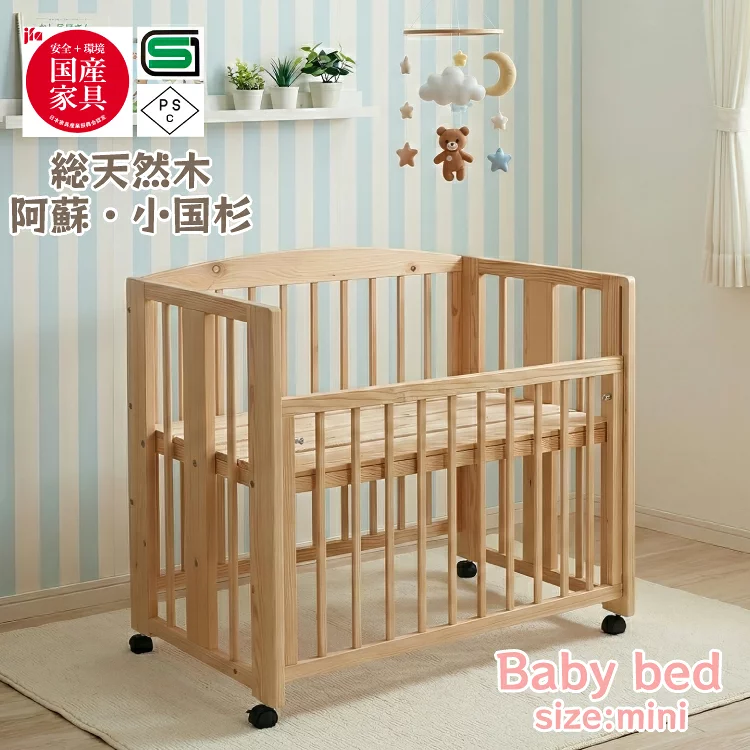
Oguni Sugi Unfinished Solid Cedar Mini Baby Crib
国産 ベビーベッド 小国杉 無垢材 無塗装 熊本 阿蘇 PSCマーク SGマーク 適合 認定商品 ハイタイプ ロータイプ どちらも可 出産祝い ギフト プレゼント 赤ちゃん 安心 安全 舐めても安心 天然杉の香り 日本製 安眠 消臭 調湿
90 x 60 cm mini sizeGift-ready
激安家具 KA@GU
Japanese name小国杉
In northern Kumamoto's Oguni Town, families have raised cedar for about 270 years. The wood becomes pale pink boards, all-cedar plywood, and the 5,602-member truss roof of Oguni Dome.
Information last updated 36 days ago
Ordering from abroad works when the recipient has a Japanese address.
All 2 listings below are sold as gifts in the shop's own wording (ギフト, のし対応 …), marked “Gift-ready”.
国産 ベビーベッド 小国杉 無垢材 無塗装 熊本 阿蘇 PSCマーク SGマーク 適合 認定商品 ハイタイプ ロータイプ どちらも可 出産祝い ギフト プレゼント 赤ちゃん 安心 安全 舐めても安心 天然杉の香り 日本製 安眠 消臭 調湿
激安家具 KA@GU
 3 images
小国杉の キッチンミトン / 5本指 キッチンミトン 鍋つかみ オーブンミトン / プレゼント 母の日 父の日 誕生日 プレゼント 新築祝い / キャンプ キャンプ女子 / ホールガーメント / メンズ レディース 【 送料無料 】
軍手工房 老舗の工場直売店
4.8 / 4 reviews
First time buying on Rakuten? How residents in Japan order →
At the northern edge of Kumamoto Prefecture, where central-northern Kyushu rises toward the Aso highlands, the town of Oguni has made its living from cedar for generations. The wood it raises, Oguni cedar, grows on managed hillsides outside the Aso caldera's rim and is dried with the same geothermal heat that warms the town's farms and baths. From those slopes it becomes pale pink boards, dense structural timber, plywood made entirely of local cedar, the great truss roof of Oguni Dome, interiors at Aso Kumamoto Airport, and smaller woodwork and aroma oil. From the forest floor to the places people meet it, the cedar keeps one address: the foothills of Aso.
Oguni Town lies at the northern tip of Kumamoto Prefecture, on the outer side of the Aso caldera's rim, where central-northern Kyushu rises into the skirts of the Aso highlands. Geothermal heat and biomass shape daily farming and forestry here, and cedar plantations form the backbone of the surrounding hills. The woodland is old: generations of planting have left stands of many ages, including high, long-grown cedar. Where the forest is well tended the interior stays bright, undergrowth spreads across the floor, and the shrub layer fills in — enough for scarce plants such as the orchid kiebine to take hold. In the sawtooth-oak groves near the hamlets, birds like the pale thrush and the daurian redstart pass the winter. This is the ground that produces Oguni cedar.
For roughly 270 years, families in Oguni Town have raised the cedar now carried under the name Oguni cedar. The head of the local forest cooperative still keeps a stand of cedar about 270 years old, remembered as the place where Oguni's forestry began. That long horizon is practical as much as sentimental: cedar planted by one generation is cut and sold by a later one, so the work is organised to hand living forest forward rather than to clear it at once. The town calls itself a forestry town, and the cooperative that anchors the trade was founded in 1951.
Oguni handles cedar from the mountain to the finished piece through its forest cooperative, a body of 34 staff as of April 2025, working across forest maintenance, planning and sales, general affairs, and cadastral survey. The cooperative runs a planning-and-sales desk, so logs reaching the market are not the end of its work; it carries the wood on into planning, manufacture, and sale. Umeki Takahiro, who grew up in Oguni and joined in 1994, spent years on the mountain side before moving to that desk in 2017; Irimajiri Ritsuka, who studied forest policy and moved to the town in 2012, works on telling the forest's story. Felling, hauling, sawing, and woodworking connect through the same organisation, and the cooperative took on a retiring craftsman's woodworking machinery through his apprentice. Nearby, the Oguni Woody Cooperative keeps a large modern sawmill that cuts and sells the same cedar.
In the 1980s the town built a plan around using its own wood, and thinned cedar — the smaller trees removed so the rest can grow — went into public buildings. The roadside station known as Yu Station and the Oguni Dome both came out of that program. The dome's roof is a wooden space-truss assembled from 5,602 Oguni-cedar members; because a timber frame on that scale sat outside the ordinary building rules of the day, it went up only after strength testing backed a special permission. Walking into these buildings, residents and visitors meet the town's cedar overhead rather than on a shelf.
Before Oguni cedar leaves the valley it is dried using local geothermal heat, the same underground warmth that marks the town's farming and bathing. The cooperative's forests carry SGEC forest-management certification in part, and the wood can be traced back to where it grew — practical habits that keep the hillsides productive rather than idle. The town's logic is plain: the surest way to protect a well-managed cedar forest is to keep selling what it yields, so Oguni works to hold and raise its timber shipments, and a carbon-offset scheme adds value to the standing forest to help pay for its upkeep.
Cut and dried, the cedar shows a pale pink face that makes it easy to recognise in boards and panelling. Denser, heavier logs become structural timber, and sheets of it are pressed into structural plywood made entirely of Oguni cedar, which has gone into interiors at Aso Kumamoto Airport, where the cooperative also laid out a zone of Oguni-cedar furniture. The same tree reaches people at smaller scale too — turned and jointed woodwork, decorative and interior panels, large and special-sized pieces for particular jobs, and even an aroma oil drawn from the wood. From a roof truss to a bottle of oil, the range stays rooted in one town's hillsides.
Oguni cedar is the product of one northern-Kumamoto town working its own hills for about 270 years and still finding new places to put the wood. The forest cooperative ties forest owners, fellers, haulers, sawyers, and woodworkers into a single line of work; geothermal heat dries the boards; and the results stand overhead in Oguni Dome, line the interiors of Aso Kumamoto Airport, and sit in the hand as woodwork and aroma oil. It is a material whose address you can point to, grown and finished at the foot of Aso.
Compiled from public records and official sources; see the recognition links below. Details may change over time.
Where this product is officially registered, designated, or recognized in Japan.
Regional collective trademark
Registered as a Regional Collective Trademark with the Japan Patent Office.
Sources1
It is written as 小国杉 in Japanese. Search Rakuten and other Japanese sites with that spelling — the English name will not bring up the listings.
Oguni cedar (Oguni-sugi) is cedar timber grown in Oguni Town, Aso District, Kumamoto, on the outer side of the Aso caldera rim at the prefecture's northern edge. Local families have raised it for about 270 years, and it becomes pale pink boards, dense structural timber, structural plywood, woodwork, and aroma oil. The Oguni Town Forest Cooperative handles the wood from forestry to sale and dries it with geothermal heat.
The Oguni Town Forest Cooperative was founded in 1951 and had 34 staff as of April 2025. Structural plywood made entirely of Oguni cedar was used in interiors at Aso Kumamoto Airport. Oguni Dome's roof is a wooden space-truss built from 5,602 Oguni-cedar members. A 1980s town building program placed thinned cedar in public buildings including Yu Station and Oguni Dome.
The dense structural timber and 100% Oguni-cedar structural plywood suit building and construction use. The range includes woodwork and aroma oil, and the cooperative is experimenting with new uses such as aroma oil and design products. The cooperative worked with woodworkers living in Oguni Town to create an Oguni-cedar furniture zone inside Aso Kumamoto Airport.
Keep wood, bamboo, and lacquer out of prolonged soaking, dishwashers, and direct sun — wipe dry after use and let them air out in the shade. For metal and fabric goods, follow the care notes on the listing.
Rules for this kind of item vary by destination, and fresh, raw or unprocessed versions are the ones most often restricted, so check the rules where you're flying before you pack it.
On Rakuten: the shops listed here right now are 激安家具 KA@GU, 軍手工房 老舗の工場直売店. We don't sell directly; purchase, payment, stock, and delivery are all handled on the Rakuten product page.