 3 images
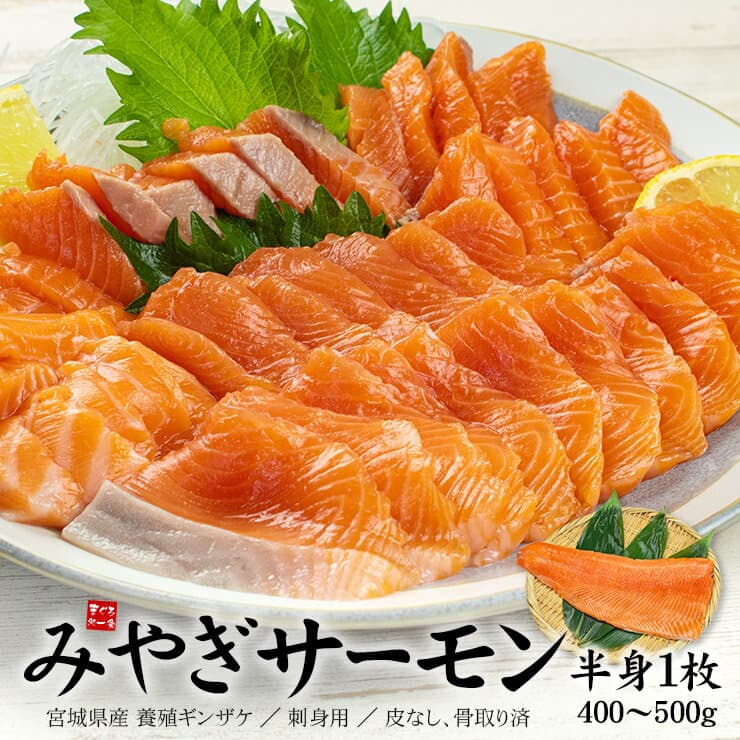
Miyagi Salmon Skinless Boneless Half Fillet
\クーポン使用で1,000円OFF/父の日 ギフト プレゼント みやぎサーモン 半身(400~500g) 皮なし骨取り済 養殖 まるで生のような食感 送料無料(国産 2026 父の日 敬老の日 刺身 海鮮丼 手巻き寿司 おつまみ 誕生日 御祝 内祝 鮭 oss)[[みやぎサーモン]
400-500g half filletまぐろ処 一条
4.6 / 66 reviews
Japanese nameみやぎサーモン
Miyagi Salmon comes from Ishinomaki, Onagawa, Minamisanriku, and Kesennuma, where cold bays, ikejime, bleeding, and low-temperature seawater tanks shape glossy, firm coho salmon for sashimi and cooking.
Information last updated 119 days ago
3 images\クーポン使用で1,000円OFF/父の日 ギフト プレゼント みやぎサーモン 半身(400~500g) 皮なし骨取り済 養殖 まるで生のような食感 送料無料(国産 2026 父の日 敬老の日 刺身 海鮮丼 手巻き寿司 おつまみ 誕生日 御祝 内祝 鮭 oss)[[みやぎサーモン]
400-500g half filletまぐろ処 一条
4.6 / 66 reviews
 3 images
宮城県産 みやぎサーモン
assorted cuts setGACKT × OCEAN
5.0 / 1 reviews
First time buying on Rakuten? How residents in Japan order →
Along Miyagi Prefecture’s Pacific coast, the bays of Ishinomaki, Onagawa, Minamisanriku, and Kesennuma place coho salmon farms in deep, comparatively calm ria waters. Miyagi Salmon is coho salmon raised in Miyagi and handled after landing through ikejime, bleeding, and seawater tanks kept around 5°C or lower. Those steps lead to the qualities people notice on the plate: glossy, firm flesh for sashimi, little fishy odor, and enough ease with other ingredients to move into many cooked dishes.
Miyagi Salmon is tied to four coastal places: Ishinomaki City, Onagawa Town, Minamisanriku Town, and Kesennuma City. The fish is coho salmon raised in Miyagi and treated after landing to preserve freshness, so the name carries both place and a specific handling routine.
The work around the fish stretches across sea farms, fish markets, processors, feed companies, and local governments. In March 2013, after the damage of the 2011 earthquake, the Miyagi Ginzake Promotion Council brought producers, trading firms, feed makers, local fish markets, and municipalities into one regional effort.
North of the Oshika Peninsula, the Miyagi coast forms a classic ria landscape with deep water and sheltered bays. Coho salmon farms benefit from that setting, and the seawater in the area stays below 20°C until late July, a temperature pattern suited to raising the fish at sea.
The route from inland water to coastal farms is also short. Miyagi has nearby hatchery and juvenile fish facilities using water connected with snowmelt from areas such as the Zao mountain system; young fish can move to sea farms with less travel stress. Fish markets and processing sites near the coast keep post-landing work close to the farming area.
The freshness of Miyagi Salmon depends on what happens immediately after landing. During ikejime, workers destroy the central nerve with a tool such as an awl, bleed the fish, and place it in seawater tanks kept around 5°C or lower.
The result appears in the flesh. When a knife enters the fish, the flesh can feel as if it grips the blade; the cut surface is glossy, and the texture has firmness. These tactile details are part of why the salmon is used for sashimi.
Miyagi became an early home for farmed coho salmon in Japan during the 1970s, with aquaculture beginning around 1976 and full-scale farming starting in 1977. Coho grows quickly, and Miyagi’s bays, water temperatures, and coastal facilities gave the fish a strong place in local aquaculture.
Around 1996, producers moved from raw feed to formulated feed. That change reduced odor associated with raw feed and worked alongside better ikejime handling to support farmed coho salmon for raw preparations.
A later experiment brought Miyagi-grown rice into feed for some coho salmon. From 2016, researchers and prefectural fisheries staff tested rice-blended feed at farms including Minamisanriku, changing rice types and ratios to find where rice could replace part of the wheat flour.
By 2018, feed containing 30% Miyagi-grown feed rice was in use by some producers. At that time, 16 operators were using feed rice and planned around 3,400 tons of rice-fed coho salmon; the rice feed belongs to a concrete group of producers, while the wider name remains tied to Miyagi coastal farming and post-landing handling.
The March 2011 Great East Japan Earthquake severely damaged Miyagi’s coho salmon aquaculture. Producers worked to restart in 2012, and in March 2013 the Miyagi Ginzake Promotion Council formed with producer groups, trading firms, and feed companies; local fish markets and related municipalities joined afterward.
Its work rests on specific coastal members: Ishinomaki Fish Market, Onagawa Fish Market, fisheries cooperatives, feed departments, and local fisheries offices. After the earthquake, sea farms, feed, processing, and distribution all had to return to working order, and the council gathered those parts into one regional industry network.
Miyagi Salmon is often discussed through sashimi because ikejime, bleeding, and chilled seawater tanks leave the flesh glossy and firm. The tight texture, mild odor, and sweetness of coho salmon make it suitable for raw slices.
The same low odor helps the fish in cooked dishes with vegetables, rice, miso, and other ingredients. The farming season runs from November to July, with the peak around June and July, giving Miyagi’s coho salmon a seasonal rhythm from late spring into midsummer.
Seen from the Miyagi coast, Miyagi Salmon follows a concrete line: coho raised in the bays of Ishinomaki, Onagawa, Minamisanriku, and Kesennuma; ikejime, bleeding, and seawater tanks around 5°C or lower after landing; and a post-2011 council connecting producers, fish markets, feed companies, and local governments. The line ends in glossy, firm salmon flesh that can be sliced for sashimi and handled easily in cooking.
Compiled from public records and official sources; see the recognition links below. Details may change over time.
Where this product is officially registered, designated, or recognized in Japan.
Geographical Indication (GI)
Registered under Japan's Geographical Indication Protection System, run by the Ministry of Agriculture, Forestry and Fisheries.
Sources1
It is written as みやぎサーモン in Japanese. Search Rakuten and other Japanese sites with that spelling — the English name will not bring up the listings.
Miyagi Salmon is farmed coho salmon raised in Ishinomaki, Onagawa, Minamisanriku, and Kesennuma in Miyagi Prefecture, handled after landing through ikejime, bleeding, and seawater tanks around 5°C or lower. The prefecture's ria coast gives farms deep, calm bays, with seawater staying below 20°C until late July. Its glossy, firm flesh suits sashimi, carries little fishy odor, and pairs easily with many dishes.
Coho salmon aquaculture in Miyagi began around 1976 and moved into full-scale farming in 1977. Around 1996, producers shifted from raw feed to formulated feed while improving ikejime handling to allow farmed coho salmon to be eaten raw. Rice-blended feed trials began in 2016 at farms including Minamisanriku, and by 2018 some producers used feed containing 30% Miyagi-grown feed rice. After the 2011 earthquake damaged Miyagi coho salmon aquaculture, the Miyagi Ginzake Promotion Council formed in March 2013 with producers, feed companies, fish markets, and municipalities.
The flesh is fresh enough to be eaten raw, with a glossy, firm texture suited to sashimi. Because it has little fishy odor, it pairs easily with other ingredients and can be prepared with various cooking methods. Domestic coho salmon farming runs from November through July, with shipments peaking in June and July; in the production area, same-day fresh delivery is possible during the March to July season.
Storage varies by product — shelf-stable, refrigerated, or frozen — and is stated on the packaging and the Rakuten listing. Shelf-stable processed foods usually need refrigerating once opened and eating within a few days; chilled and frozen items go straight into storage on arrival. Treat the best-before date on the physical packaging as authoritative.
Most options are shelf-stable, boxed, and travel well, so they suit gifting or bringing home. Confirm the final storage and delivery terms on the Rakuten listing.
On Rakuten: the shops listed here right now are まぐろ処 一条, GACKT × OCEAN. We don't sell directly; purchase, payment, stock, and delivery are all handled on the Rakuten product page.