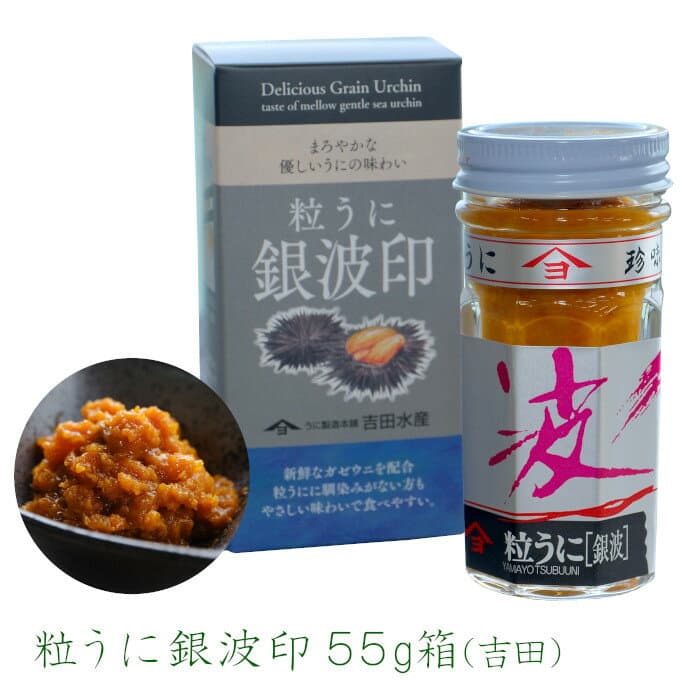
Yoshida Suisan Ginpa Brand Tsubu Uni
粒うに銀波印55g 箱入り 吉田水産 下関 うに 粒うに 瓶うに 瓶詰め ごはん ご飯のお供 おかず おつまみ 珍味 手土産 みやげ
55g boxed海匠 國近
Japanese name下関うに
Shimonoseki uni connects Yamaguchi waters, a Saikyoji temple anecdote on Mutsurejima, and bottled and tsubu-uni.
Information last updated 119 days ago
粒うに銀波印55g 箱入り 吉田水産 下関 うに 粒うに 瓶うに 瓶詰め ごはん ご飯のお供 おかず おつまみ 珍味 手土産 みやげ
55g boxed海匠 國近
First time buying on Rakuten? How residents in Japan order →
In Shimonoseki, Yamaguchi Prefecture, uni is counted among the city's five major seafood brands, especially through bottled uni and tsubu-uni. The local background begins with the coast: sea urchin fossils from the Jomon-period Shiomachi shell mound are described as about 5,000 years old. A modern origin account turns to early Meiji-era Mutsurejima, where gin is said to have spilled into a small bowl of uni during a conversation at Saikyoji temple, giving rise to alcohol-pickled uni. Across Yamaguchi, seaweed-rich waters support bafun uni, aka uni, and murasaki uni; bafun uni is harvested mainly from June to July and is used for bottled processing.
The outline of Shimonoseki uni begins with the city's coastal food identity. Uni is counted among Shimonoseki's five major seafood brands, and the city is described as the birthplace of bottled uni and the home of tsubu-uni. The point is not to fold every Yamaguchi sea urchin into one city name; it is to see why Shimonoseki is closely tied to bottled and granular processed uni.
Shiomachi shell mound gives the Shimonoseki coast a much older connection to sea urchins. Sea urchin fossils from the Jomon period, about 5,000 years ago, have been found there. That archaeological detail supports a long coastal encounter with uni, while the modern processed food belongs to a later setting around Mutsurejima and Yamaguchi seafood processing.
The most concrete modern origin scene is set at Saikyoji temple on Mutsurejima. In the early Meiji era, the monk Hozan was speaking with a British pilot when gin is said to have spilled into a small bowl of uni; the taste that followed became the local account of how alcohol-pickled uni began. The bowl, the gin, and the island temple give the origin account a precise place and object rather than a vague claim of antiquity.
The broader material setting is Yamaguchi Prefecture's waters on both the Japan Sea and Seto Inland Sea sides. The main sea urchins landed in the prefecture are bafun uni, aka uni, and murasaki uni, and the edible part is the gonad inside the shell. Seaweed is the sea urchin's food, so Yamaguchi's seaweed-rich waters matter as a material background for uni quality.
After harvest, producers split the shells and ship only the gonads, so whole sea urchins in the shell are rarely part of this distribution context. That first handling step connects the shore to bottled processing. Bafun uni is landed mainly from June to July, and the June catch is used for bottled uni and related processed products.
Among Yamaguchi's processed uni names, Shimonoseki uni appears alongside Kitaura uni. Bottled uni in the prefecture includes alcohol-pickled uni and salted uni, and Yamaguchi accounts for about four tenths of national bottled uni production; Shimonoseki uni and Kitaura uni have also been handled as regional collective trademarks. Here the administrative context is most useful when it clarifies place, product form, and producer community rather than becoming the main subject.
Shimonoseki uni is strongest when told through concrete places and handling: the Shiomachi shell mound, the small bowl at Saikyoji temple on Mutsurejima, seaweed-rich Yamaguchi waters, and the work of splitting shells to take only the gonads. Bottled uni and tsubu-uni gather those details into a local food form remembered between coast, island temple, and processing table.
Compiled from public records and official sources; see the recognition links below. Details may change over time.
Where this product is officially registered, designated, or recognized in Japan.
Regional collective trademark
Registered as a Regional Collective Trademark with the Japan Patent Office.
Sources1
It is written as 下関うに in Japanese. Search Rakuten and other Japanese sites with that spelling — the English name will not bring up the listings.
Shimonoseki uni is a Yamaguchi regional food name tied especially to bottled uni and tsubu-uni, and Shimonoseki counts uni among its five major seafood brands. The city describes itself as the birthplace of bottled uni and the hometown of tsubu-uni. Yamaguchi lands bafun uni, aka uni, and murasaki uni, and the edible part is the gonad.
Yamaguchi bottled uni includes alcohol-pickled uni and salted uni, and the prefecture accounts for about four tenths of national bottled uni production. Sea urchin fossils from about 5,000 years ago, in the Jomon period, were found at Shimonoseki's Shiomachi shell mound. An early Meiji account from Saikyoji temple on Mutsurejima says gin spilled into a small bowl of uni during a conversation between the monk Hozan and a British pilot, leading to alcohol-pickled uni. Bafun uni is landed mainly from June to July, and the June catch is used for bottled uni and similar processed products.
It is handled as processed uni in bottled uni or tsubu-uni form, with a small amount added to rice or served as an accompaniment to drinks. It is eaten raw as well as in bottled, alcohol-pickled, and salted forms.
Storage varies by product — shelf-stable, refrigerated, or frozen — and is stated on the packaging and the Rakuten listing. Shelf-stable processed foods usually need refrigerating once opened and eating within a few days; chilled and frozen items go straight into storage on arrival. Treat the best-before date on the physical packaging as authoritative.
Most options are shelf-stable, boxed, and travel well, so they suit gifting or bringing home. Confirm the final storage and delivery terms on the Rakuten listing.
On Rakuten: the shops listed here right now are 海匠 國近. We don't sell directly; purchase, payment, stock, and delivery are all handled on the Rakuten product page.