Ouchi Doll Special No. 28 by Kuwabara Ouchi-nuri Ouchi Doll Workshop
大内人形 特28号 ガラスケース入り (桐ガラスケース大)山口県の伝統工芸品 大内塗 桑原大内塗大内人形製作所 OU-KW-T28-C結婚祝い 縁起物 記念品 プレゼント お土産 海外 雛人形 ひな人形 親王飾り 桃の節句 重陽の節句 漆塗り うるし塗り
人形の丸富
5.0 / 1 reviews
Japanese name大内塗
Ouchi-nuri takes shape in bowls, trays, tea saucers, chopstick boxes, and paired lacquer dolls, with deep red ground, gold leaf, diamond motifs, and carefully painted faces linking Yamaguchi City craft to older Ouchi-era lacquerwork.
Information last updated 5 days ago
Ordering from abroad works when the recipient has a Japanese address.
2 of the 4 listings below are sold as gifts in the shop's own wording (ギフト, のし対応 …), marked “Gift-ready”.
大内人形 特28号 ガラスケース入り (桐ガラスケース大)山口県の伝統工芸品 大内塗 桑原大内塗大内人形製作所 OU-KW-T28-C結婚祝い 縁起物 記念品 プレゼント お土産 海外 雛人形 ひな人形 親王飾り 桃の節句 重陽の節句 漆塗り うるし塗り
人形の丸富
5.0 / 1 reviews
大内人形 セット飾り お道具付き 畳付 特28号 桐箱入り山口県の伝統工芸品 大内塗 桑原大内塗大内人形製作所 OU-KW-T28-TSET結婚祝い 縁起物 記念品 プレゼント お土産 海外 雛人形 ひな人形 親王飾り 桃の節句 重陽の節句 漆塗り うるし塗り
人形の丸富
5.0 / 1 reviews
【山口県】【山口市大内御堀】【大内塗】【中村民芸社】 長寿箸二膳
やまぐち開盛堂
5.0 / 1 reviews
大内ひな人形 伝統工芸「大内塗り」のひな人形(消費税10%)
有機家
4.5 / 2 reviews
First time buying on Rakuten? How residents in Japan order →
All 4 listings of this product on Rakuten, lowest price first.
| Listing | Price | Shop | Reviews | Open listing |
|---|---|---|---|---|
Ouchi-nuri Nakamura Mingeisha Longevity Chopsticks 2 pairsLowest price | ¥2,016 | やまぐち開盛堂 | 5.0 / 1 reviews | View on Rakuten → |
Ouchi-nuri Lacquer Hina Dolls male and female doll set, paulownia box | ¥34,092 | 有機家 | 4.5 / 2 reviews | View on Rakuten → |
Ouchi Doll Special No. 28 by Kuwabara Ouchi-nuri Ouchi Doll Workshop glass case, large paulownia caseGift-ready | ¥38,000 | 人形の丸富 | 5.0 / 1 reviews | View on Rakuten → |
Ouchi Dolls Display Set by Kuwabara Ouchi-nuri Ouchi Doll Studio Special No. 28, with tools, tatami and paulownia boxGift-ready | ¥47,000 | 人形の丸富 | 5.0 / 1 reviews | View on Rakuten → |
Japanese · new tab
The first signal of Ouchi-nuri is often the red: a deep ground color laid over shaped wood, then worked with gold leaf, colored lacquer, and fine painted lines. In Yamaguchi City, the lacquerware appears as bowls, trays, small plates, tea saucers, chopstick boxes, and the rounded paired figures known as Ouchi dolls. Each object carries the craft through material steps that can be seen up close: drying wood, turning a base, coating and sanding lacquer, controlling moisture, transferring leaf, and drawing the final details.
Ouchi-nuri is centered in Yamaguchi City and appears across several forms rather than one fixed object. Local descriptions name bowls, trays, confectionery bowls, individual plates, stationery boxes, tiered boxes, flower vessels, chopstick boxes, tea saucers, banquet trays, and Ouchi dolls. The same lacquer family can therefore sit on a table, hold writing things, or stand as a small household figure.
The paired Ouchi doll gives the craft one of its most familiar shapes. It is associated with marital harmony, and local experience programs focus on drawing the face, making chopsticks, or applying lacquer and gold leaf to small accessories. These activities keep the material vocabulary visible: red ground, colored lacquer, metal leaf, and a hand steady enough for small curves.
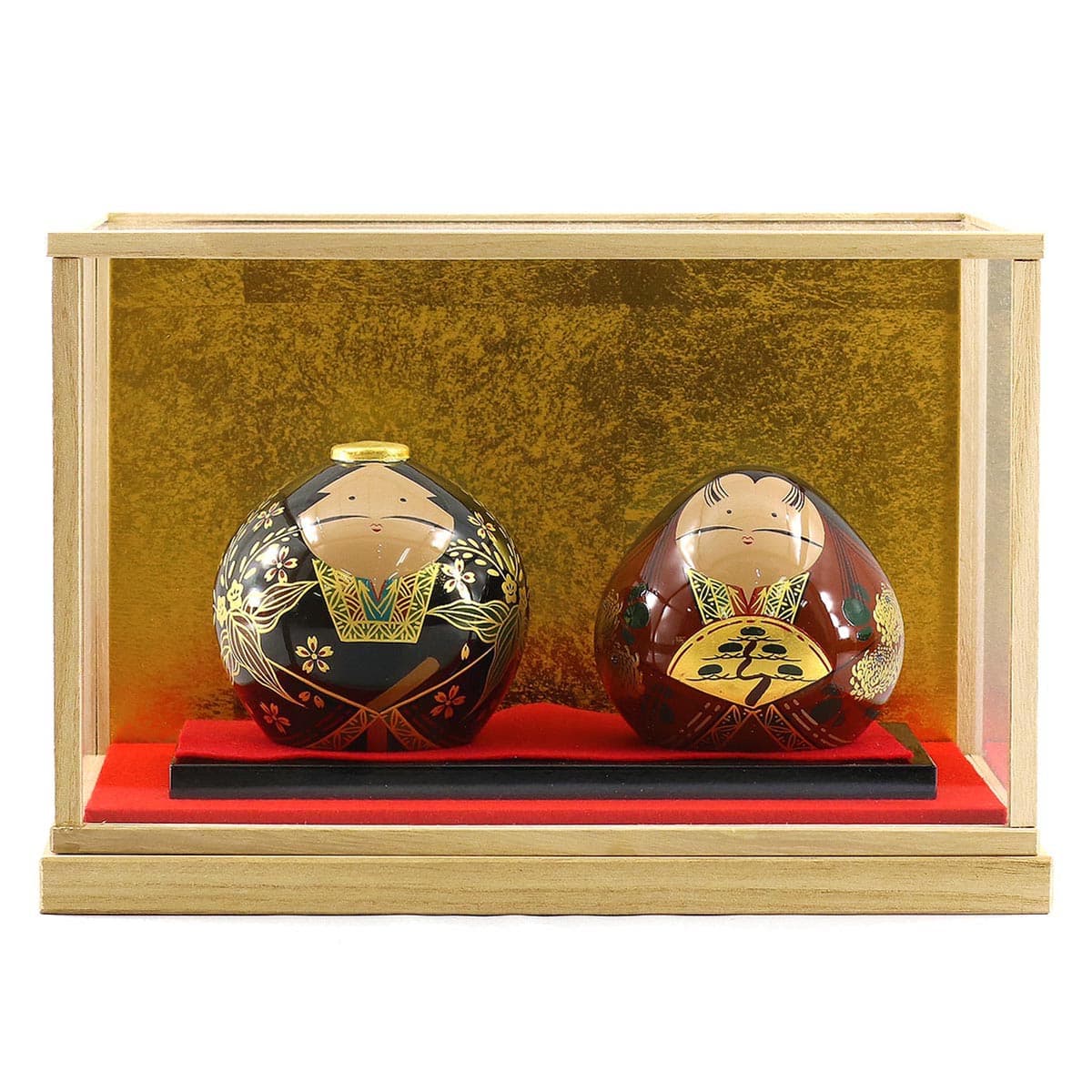
The surface language of Ouchi-nuri begins with deep Ouchi red. On that red ground, gold leaf and colored lacquer create motifs such as Ouchi diamonds, cloud forms, and branch chrysanthemums. Older Ouchi bowls show the combination clearly: red iron-oxide lacquer below, black lacquer and yellow lacquer in the design, and gold leaf catching light across the pattern.
Those motifs give each object a readable face. A lidded bowl, a flat bowl, a tray, or a doll carries the Yamaguchi lacquer vocabulary when the red ground, diamond shapes, and leaf work are present on its surface.
The early history is best read through concrete traces. The exact origin of Ouchi-nuri is not settled, but lacquer goods appear in the Ouchi clan’s trade with Korea and Ming China, and Yamaguchi is described as a place where lacquer craft was active in the 15th century. Lacquer sat among other traded objects such as swords, fans, and inkstones.
Only a small number of Ouchi-related lacquer pieces from that period are described as surviving. The lacquer-painted branch chrysanthemum bowls preserved through the Mori family form a set of four bowl types, and a four-legged lacquer tray bears an inscription from 1478. The bowls and tray give the history its weight because they name real forms, colors, dimensions, and patterns rather than a vague memory of a style.
Yamaguchi lacquerwork also has an Edo-period thread. Local descriptions mention bowl makers and substantial bowl production, placing lacquered tableware in the work of the city after the medieval Ouchi period. The bowl remains important because it connects old patterned examples with later local making.
In the Meiji period, Kondo Kiyoshi studied older Ouchi bowls and worked with lacquer craftspeople in Yamaguchi to revive the craft under the Ouchi-nuri name. Continuity here comes from specific actions: looking at old bowls, rebuilding techniques with local lacquer workers, and giving the name renewed use in Yamaguchi.
The making begins before the red surface appears. Wooden bases may use materials such as zelkova, camphor, horse chestnut, cherry, and other woods named in process descriptions. The wood is dried and shaped, often by turning, before the ground layers and cloth application prepare it for lacquer.
Lacquer is then filtered, coated, dried, sanded, and coated again. Moisture matters because lacquer cures under suitable humidity, so drying chambers are part of the workshop process. Gold leaf transfer, leaf application, color matching, and painting follow; the finished shine is built from wood, water in the air, repeated abrasion, lacquer layers, and leaf work.
On an Ouchi doll, the broad history of lacquerwork narrows to a few lines on a face. In Yamaguchi face-painting sessions, colored lacquer is used for the eyes, eyebrows, and mouth, and makers point to the eyes as the part that needs particular care. A small change in those lines changes the doll’s smile.
Because the paired dolls are associated with marital harmony, the face carries much of the meaning. The rounded body, red lacquer surface, and careful eyes bring the craft into a household setting where display, blessing, and handwork meet on a palm-sized object.
Present-day Ouchi-nuri remains visible through makers and organizations in Yamaguchi City, including the Ouchi-nuri lacquerware promotion cooperative and named handlers such as Nakamura Mingeisha and Taniguchi Shikkodo. Their work includes Ouchi-nuri lacquerware, Ouchi dolls, face-painting guidance, accessory experiences, and collaboration with universities in the prefecture.
The same local context also carries a difficulty: lacquer painters require long training, and succession is noted as a challenge. That gives the current craft a practical shape. Bowls, trays, dolls, and small lacquer objects remain visible because people in Yamaguchi continue to teach drying, coating, sanding, leaf application, and painted detail.
Ouchi-nuri is strongest when seen through its objects: a red bowl with gold-leaf motifs, a tray with black outside and red inside, a paired doll with carefully drawn eyes. Through those forms, Yamaguchi City lacquerwork connects Ouchi-era trade goods, Edo-period bowls, Meiji revival work, and present-day makers who still build color one layer at a time.
Compiled from public records and official sources; see the recognition links below. Details may change over time.
Where this product is officially registered, designated, or recognized in Japan.
Traditional craft
Designated a Traditional Craft (dentō kōgeihin) by Japan's Ministry of Economy, Trade and Industry.
Sources1
It is written as 大内塗 in Japanese. Search Rakuten and other Japanese sites with that spelling — the English name will not bring up the listings.
Ouchi-nuri is a Yamaguchi City lacquerware family found in bowls, trays, tea saucers, chopstick boxes, and Ouchi dolls. Its surface is defined by deep Ouchi red, gold leaf, colored lacquer, Ouchi diamond motifs, cloud forms, and branch chrysanthemums. Its historical thread runs through Ouchi clan trade with Korea and Ming China, Edo-period bowl production in Yamaguchi, and a Meiji revival led by Kondo Kiyoshi with local lacquer craftspeople.
The surviving Ouchi bowls include four bowl types and use red ground, gold leaf, black lacquer, yellow lacquer, and painted motifs. Ouchi-era lacquer goods are connected with trade involving Korea and Ming China, while the exact origin of Ouchi-nuri is not settled. Ouchi-nuri making includes drying and shaping wooden bases, repeated lacquer coating and sanding, humidity-controlled drying, gold leaf work, and painting. Ouchi dolls are associated with marital harmony, and makers treat the drawing of the eyes as especially careful work.
Ouchi dolls are displayed in the home as a symbol of marital harmony. Tableware such as bowls, trays, tea saucers, and chopstick boxes is used for everyday dining, with Ouchi bowls often used as a four-piece set. In Yamaguchi City, visitors can join experience sessions such as painting Ouchi dolls or making chopsticks to learn the techniques.
Porous earthenware is usually given a "medome" treatment first — simmer it gently in rice-rinsing water (or water with a little flour), then cool, rinse, and air-dry. This reduces staining and odour absorption. Porcelain normally just needs a wash. Follow the listing where it says otherwise.
Handmade earthenware, pieces with gold or silver overglaze, and lacquerware generally should not go in a dishwasher, microwave, or heated drying cabinet; heat-resistant porcelain usually can. Check the Rakuten listing for the specific piece.
Most options are shelf-stable, boxed, and travel well, so they suit gifting or bringing home. Confirm the final storage and delivery terms on the Rakuten listing.
On Rakuten: the shops listed here right now are 人形の丸富, やまぐち開盛堂, 有機家. We don't sell directly; purchase, payment, stock, and delivery are all handled on the Rakuten product page.