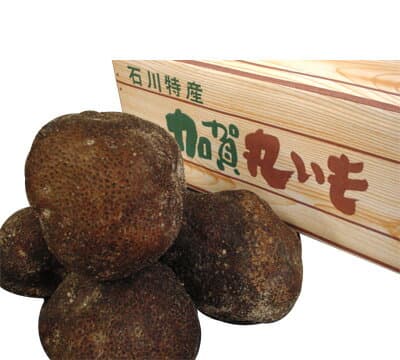
Kaga Maruimo Yam
加賀丸いも[産直 石川県]5kg
5 kg近江町北形青果
4.8 / 12 reviews
Japanese name加賀丸いも
In Nomi City and part of Komatsu, a black-skinned yam grows round and dense; grated, its low moisture and firm flesh become tororo that pulls into long strands.
Information last updated 119 days ago
加賀丸いも[産直 石川県]5kg
5 kg近江町北形青果
4.8 / 12 reviews

加賀丸いも[産直 石川県]1箱 3kg
1 box, 3 kg近江町北形青果
4.9 / 8 reviews
First time buying on Rakuten? How residents in Japan order →
At the southern edge of Ishikawa, in Nomi City and Komatsu's Takado, Noda, and Hitotsuhari districts, Kaga Maruimo grows as a black-skinned yamatimo with a round body. Its flesh holds little moisture, so a grated portion can pull into 20 to 30 centimeter strands of tororo before it reaches rice, soup, nori, or a hot pan.
The growing area for Kaga Maruimo sits in Nomi City and in Komatsu's Takado, Noda, and Hitotsuhari districts. The yam belongs to a black-skinned yamatimo type, with a body often compared to a softball or to an adult man's fist. Its round shape reduces waste when peeled, while its dense, low-moisture flesh gives grated tororo a grip that can be lifted and stretched with chopsticks.
The Tedori River spreads into an alluvial fan around Nomi, and the 1934 flood pushed river sand into former paddy fields where it mixed with clayey soil. That softer, better-drained ground became one condition for growing larger, rounder yams, so the shape of Kaga Maruimo is tied to a river event still visible in the field soil.
Cultivation has continued for more than 100 years from the early Taisho period. Local accounts connect early spread with Sawada Jinzomatsu and Akita Chusaku, and by 1935 the name Kaga Maruimo was already used in Neagari village. Around 1971, the wider southern Kaga area also began using Kaga Maruimo as a shared name.
The field year begins around April, when growers make high ridges with dedicated machinery and plant the seed yams in soft, well-drained soil. When shoots appear around June, supports and plastic twine go up; in July, vines are trained along them. Harvest usually comes in October to November, after the aboveground stems and leaves have withered.
Once grated, Kaga Maruimo can be loosened with dashi and poured over hot rice, or spooned into clear soup, miso soup, and hot pot as dumplings that hold together. Its strong viscosity also suits isobe-age with nori or green shiso, and a flourless okonomiyaki style where the yam brings both fluffiness and chew.
The same stickiness and yam aroma move into soba, udon, jojo manju, wagashi, fish-paste products, shochu, and croquettes. In these foods, Kaga Maruimo is valued as a texture-giving ingredient, carrying the round yam from the rice bowl into steamed sweets, noodles, and processed fish cakes.
After harvest, Kaga Maruimo is easily damaged and weak against drying, so it is kept with sawdust in a cool, dark place. Freshly dug yams are juicy, while the flavor becomes deeper after about a year. Nomi City also faces aging producers and fewer farms, even as younger growers begin cultivating the round yam in the same area.
Seen from a bowl of tororo, Kaga Maruimo may look simple: a black-skinned round yam, peeled and grated. Its fuller shape comes from Nomi and Komatsu fields shaped by Tedori River sand, its texture from low moisture and dense flesh, and its yearly rhythm from April planting, summer supports, vine training, and autumn harvest. Rice, soup, isobe-age, wagashi, noodles, and fish-paste products all carry that texture into winter tables.
Compiled from public records and official sources; see the recognition links below. Details may change over time.
Where this product is officially registered, designated, or recognized in Japan.
Geographical Indication (GI)
Registered under Japan's Geographical Indication Protection System, run by the Ministry of Agriculture, Forestry and Fisheries.
Sources1
It is written as 加賀丸いも in Japanese. Search Rakuten and other Japanese sites with that spelling — the English name will not bring up the listings.
Kaga Maruimo is a black-skinned yamatoimo grown in Nomi City and parts of Komatsu City, Ishikawa. It is round like a softball, low in moisture, and strongly sticky when grated, with tororo stretching about 20 to 30 centimeters. The 1934 Tedori River flood mixed river sand into paddy fields, creating soft, well-drained soil suited to larger, rounder yams. Cultivation has continued more than 100 years, following an April-to-November farm calendar.
After harvest it is easily damaged and weak against drying, so it is stored with sawdust in a cool, dark place; fresh yams are juicy, while flavor deepens after about a year. The farm calendar includes April planting, June supports, July vine training, and harvest in October to November after stems and leaves wither. It is grown in Nomi City and Komatsu's Takado, Noda, and Hitotsuhari districts in Ishikawa. It is also used in soba, udon, jojo manju, wagashi, fish-paste products, shochu, and croquettes.
Grated into tororo and loosened with dashi, it is served over hot rice. It can be dropped by spoon into simmering soups, including dango soup, miso soup, or hot pot, where its stickiness helps it hold shape. It is also eaten raw, sliced or grated, and used in isobe-age snacks and a flourless okonomiyaki made entirely from the yam.
Storage varies by product — shelf-stable, refrigerated, or frozen — and is stated on the packaging and the Rakuten listing. Shelf-stable processed foods usually need refrigerating once opened and eating within a few days; chilled and frozen items go straight into storage on arrival. Treat the best-before date on the physical packaging as authoritative.
Most options are shelf-stable, boxed, and travel well, so they suit gifting or bringing home. Confirm the final storage and delivery terms on the Rakuten listing.
On Rakuten: the shops listed here right now are 近江町北形青果. We don't sell directly; purchase, payment, stock, and delivery are all handled on the Rakuten product page.