 3 images
Shimamura White Miso
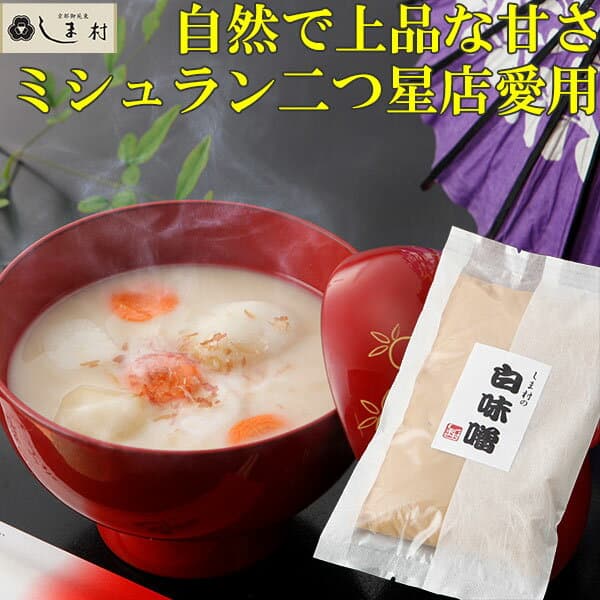
\クーポンで最大7%OFF/白味噌 「しま村の白味噌500g」 白みそ 雑煮 お雑煮 西京味噌 もつ鍋 もう一品
500g味噌通販店 京都御苑東しま村
4.8 / 189 reviews
Japanese name京味噌
Miso, soy sauce & fermented seasonings overview
Kyomiso names miso made in Kyoto Prefecture, while Saikyo Miso gives the family its clearest sweet white-miso shape: generous rice koji, low salt, short maturation, and a place in court, tea, temple, and Kyoto cuisine.
Information last updated 126 days ago
3 images\クーポンで最大7%OFF/白味噌 「しま村の白味噌500g」 白みそ 雑煮 お雑煮 西京味噌 もつ鍋 もう一品
500g味噌通販店 京都御苑東しま村
4.8 / 189 reviews
First time buying on Rakuten? How residents in Japan order →
Kyomiso begins with Kyoto Prefecture and white miso that tastes gentle before it tastes salty. The family name points to miso made in Kyoto, and Saikyo Miso gives it a concrete white-miso form: sweet white miso made in Kyoto Prefecture by member companies of the Kyoto Prefecture Miso Industrial Cooperative. Its raw materials follow the cooperative’s ingredient conditions, and its quality passes the cooperative’s check. Because the maturation is short, raw-material quality and the state of the rice koji show directly in the finished taste.
Kyomiso names Kyoto-made miso, and Saikyo Miso stands as its representative white-miso expression. The boundary points to production in Kyoto Prefecture, and the maker community gathers around the Kyoto Prefecture Miso Industrial Cooperative in Kyoto City’s Kamigyo Ward, on Muromachi-dori Ichijo.
Kyoto’s 1,200-year court-city background appears around this miso through court cuisine, tea kaiseki, Zen temple shojin cuisine, and Kyoto cuisine. The cooperative, established in April 1950, works to maintain the history and quality of Kyomiso and Saikyo Miso through Kyoto makers and shared quality conditions.
Saikyo Miso’s sweetness is built from abundant rice koji and low salt. It is a sweet white miso with plenty of rice koji; the short maturation gives raw materials and koji condition little distance from the final flavor.
Those choices create the concrete sensory profile named for this white miso: full sweetness, gentle salt, delicate aroma, and a pale character. They also make the maker’s skill visible in taste, because short maturation leaves the rice koji and raw materials close to the tongue.
Kyomiso reaches the table through named Kyoto food settings: court cuisine, tea kaiseki, Zen temple shojin cuisine, and Kyoto cuisine. In those settings, a low-salt white miso with rice-koji sweetness can season without pushing salt to the front.
The special-occasion context around Kyomiso, represented by Saikyo Miso, is concrete. The places are the palace, the tea gathering, the Zen temple, and the Kyoto kitchen; the taste anchors are sweetness, aroma, and a restrained salt profile from rice koji and short maturation.
After the Meiji Restoration, the capital moved to Edo, Edo became Tokyo, and Kyoto was called Saikyo in relation to Tokyo. Kyoto-born white miso carried that city name into Saikyo Miso.
The naming keeps a moment of geography inside a daily seasoning. Kyomiso points to Kyoto-made miso; Saikyo Miso ties that place name to the low-salt, high-koji sweet white miso made by Kyoto producers.
Saikyo Miso is bounded by people and technique. It is made in Kyoto Prefecture by companies belonging to the Kyoto Prefecture Miso Industrial Cooperative, using raw materials accepted by the cooperative and passing a quality check.
The skill conditions are concrete: a Kyoto operation of 50 years or more, a first-grade miso technician, recognition in a national miso cooperative federation appraisal, or equivalent manufacturing skill. These requirements connect the taste to breweries, technicians, rice koji, raw materials, and the Kyoto table.
Kyomiso becomes tangible through Kyoto Prefecture production, rice koji, low salt, short maturation, and Kyoto food settings. Saikyo Miso gives the family its clearest white-miso form and its post-Meiji name. In court cuisine, tea kaiseki, Zen temple shojin cuisine, and Kyoto cuisine, the gentle sweetness and aroma make the Kyoto link something a diner can taste.
Compiled from public records and official sources; see the recognition links below. Details may change over time.
Where this product is officially registered, designated, or recognized in Japan.
Regional collective trademark
Registered as a Regional Collective Trademark with the Japan Patent Office.
Sources1
It is written as 京味噌 in Japanese. Search Rakuten and other Japanese sites with that spelling — the English name will not bring up the listings.
Kyomiso is Kyoto-made miso, represented by Saikyo Miso, a low-salt, high-rice-koji sweet white miso made by Kyoto Prefecture Miso Industrial Cooperative member companies using approved ingredients under quality review. Its abundant koji and short maturation let ingredient quality show directly in the taste. Kyomiso is linked to court cuisine, tea kaiseki, Zen temple shojin cuisine, and Kyoto cuisine, and the Saikyo name reflects Kyoto's Meiji-era designation as Saikyo relative to Tokyo.
The Kyoto Prefecture Miso Industrial Cooperative is located in Kyoto City's Kamigyo Ward, on Muromachi-dori Ichijo. The cooperative was established in April 1950. One condition for the Saikyo Miso manufacturing skill certification is an operating history of 50 years or more in Kyoto Prefecture. Another condition is holding the rank of first-grade miso technician or higher.
Kyomiso, represented by Saikyo Miso, has historically been used as a hare (special-occasion) ingredient in Kyoto, rather than only in everyday cooking. As a low-salt, high-koji sweet white miso, Saikyo Miso suits dishes calling for mild sweetness and a pale color.
Storage varies by product — shelf-stable, refrigerated, or frozen — and is stated on the packaging and the Rakuten listing. Shelf-stable processed foods usually need refrigerating once opened and eating within a few days; chilled and frozen items go straight into storage on arrival. Treat the best-before date on the physical packaging as authoritative.
Most options are shelf-stable, boxed, and travel well, so they suit gifting or bringing home. Confirm the final storage and delivery terms on the Rakuten listing.
On Rakuten: the shops listed here right now are 味噌通販店 京都御苑東しま村. We don't sell directly; purchase, payment, stock, and delivery are all handled on the Rakuten product page.